Explore all 30 UNESCO World Heritage Sites in Iran, from the ancient ruins of Persepolis and the historic city of Yazd to the newly inscribed Alamut Castle. Discover more than 8,000 years of Persian civilization through archaeological treasures, imperial capitals, Persian gardens, caravanserais, and breathtaking natural landscapes in this complete travel guide.
2026/07/29
UNESCO World Heritage Sites in Iran
The Complete Guide to Iran's 30 UNESCO World Heritage Sites
Few countries tell the story of human civilization as completely as Iran. Home to one of the world's oldest continuous civilizations, Iran preserves more than 8,000 years of history through its remarkable archaeological sites, ancient capitals, historic cities, engineering masterpieces, cultural landscapes, and breathtaking natural wonders. From the ceremonial splendor of Persepolis and the timeless beauty of Yazd to the lush Hyrcanian Forests and the newly inscribed Alamut Castle, every UNESCO World Heritage Site reveals a unique chapter in the story of Persia and its enduring influence on world civilization.
As of July 2026, Iran is home to 30 UNESCO World Heritage Sites, placing it among the countries with the richest cultural heritage in the Middle East. These include 28 cultural and 2 natural World Heritage Sites that span thousands of years of human achievement. The latest addition, Alamut Castle and Related Fortifications, was inscribed during the 48th Session of the UNESCO World Heritage Committee, becoming Iran's 30th World Heritage Site and highlighting another remarkable chapter of the country's medieval history.
This comprehensive guide brings together all 30 UNESCO World Heritage Sites in Iran in one place. Whether you are planning your first journey to Iran, researching Persian history, or searching for the country's most extraordinary travel destinations, you will discover detailed information about each UNESCO site, including its historical significance, location, architectural features, and cultural importance.
Rather than simply presenting a list of monuments, this guide invites you to journey through the evolution of one of humanity's greatest civilizations. From the sacred temples of ancient Elam and the imperial capitals of the Achaemenid kings to magnificent Islamic architecture, ingenious Persian engineering, timeless caravan routes, and extraordinary natural landscapes, Iran's UNESCO World Heritage Sites reflect thousands of years of creativity, innovation, and cultural exchange that continue to inspire visitors from around the world.

Why UNESCO World Heritage Matters?
UNESCO World Heritage Sites are places recognized for their Outstanding Universal Value (OUV)—a distinction reserved for cultural and natural treasures considered important not only to one nation but to all humanity. These sites represent exceptional achievements in architecture, archaeology, engineering, science, urban planning, cultural traditions, or natural history, and are protected under the UNESCO World Heritage Convention to ensure they are preserved for future generations.
World Heritage designation is more than an international honor. It encourages conservation, promotes sustainable tourism, supports scientific research, and raises global awareness about the importance of protecting irreplaceable cultural and natural heritage. In many cases, UNESCO recognition also strengthens local communities by creating new opportunities for education, employment, and responsible tourism.
For travelers, UNESCO World Heritage Sites offer far more than beautiful landmarks. They provide authentic experiences and a deeper understanding of the people, cultures, and civilizations that shaped our world. Visiting these extraordinary places means walking through thousands of years of history while helping to support the preservation of humanity's shared heritage.
Whether exploring the ancient palaces of Persepolis, wandering through the historic streets of Yazd, admiring the engineering genius of the Persian Qanats, or hiking among the ancient Hyrcanian Forests, every UNESCO World Heritage Site in Iran tells a story that connects the past with the present and preserves it for the future.
Quick Facts About Iran's UNESCO World Heritage Sites
Chapter One
Ancient Persia
The Birth of Iranian Civilization
1. Chogha Zanbil
UNESCO World Heritage Site (1979)
Chogha Zanbil – The Ancient Elamite Ziggurat of Iran
Located near the ancient city of Susa in Khuzestan Province, Chogha Zanbil is one of the most remarkable archaeological monuments of the ancient Near East and the first site in Iran to be inscribed on the UNESCO World Heritage List in 1979.
Built around 1250 BC by King Untash-Napirisha, ruler of the Elamite civilization, Chogha Zanbil was created as a sacred city dedicated to the Elamite gods, especially Inshushinak, the patron deity of Susa. The site represents one of the greatest achievements of ancient Iranian architecture and religious construction.
The most impressive feature of Chogha Zanbil is its massive ziggurat, a unique stepped temple structure that is among the best-preserved examples of its kind outside Mesopotamia. Unlike many ancient monuments that have been heavily damaged over time, Chogha Zanbil has preserved much of its original form, allowing visitors to understand the religious beliefs, architectural skills, and urban planning of the Elamites.
The ancient complex was surrounded by three enormous defensive walls and included temples, royal areas, ceremonial spaces, and residential quarters. The construction demonstrates advanced knowledge of engineering, brick production, water management, and urban design more than 3,000 years ago.
Thousands of inscribed bricks discovered at the site provide valuable information about Elamite language, religion, and political history. These inscriptions reveal the importance of Chogha Zanbil as a spiritual center and demonstrate the sophistication of one of Iran’s earliest civilizations.
Although the city was never fully completed and later declined after the fall of the Elamite Kingdom, Chogha Zanbil remains a powerful symbol of ancient Iranian heritage. Together with other sites such as Susa and Persepolis, it represents the long continuity of civilization on the Iranian plateau.
Today, visiting Chogha Zanbil offers travelers a rare opportunity to step back into the world of ancient Persia and explore one of humanity’s earliest monumental religious landscapes. Standing among its massive brick walls and ancient temples, visitors can experience the legacy of a civilization that flourished long before the rise of the Persian Empire.
Why Visit Chogha Zanbil?
✔ The first UNESCO World Heritage Site of Iran (1979)
✔ One of the best-preserved ancient ziggurats in the world
✔ A unique symbol of the Elamite civilization
✔ More than 3,000 years of history
✔ One of the oldest examples of monumental architecture in Iran
✔ Located near the ancient city of Susa and other historical attractions
Best Time to Visit
The best time to visit Chogha Zanbil is from October to April, when Khuzestan’s climate is cooler and more comfortable for outdoor exploration.
Spring (March–April) is especially pleasant, with mild temperatures and better conditions for visiting archaeological sites in southwestern Iran.
Quick Information
📍 Location: Khuzestan Province, near Susa
🏛 Category: Cultural Heritage
📅 UNESCO Inscription: 1979
👑 Built By: King Untash-Napirisha (Elamite Empire)
⏳ Historical Period: Elamite Civilization (around 1250 BC)
🏗 Main Feature: Ancient Ziggurat and Sacred City
⏱ Recommended Visit: 1.5–2 Hours
🚗 Nearby Attractions: Susa Ancient City, Haft Tappeh Archaeological Site, Shushtar Historical Hydraulic System

02. Susa (Shush)
UNESCO World Heritage Site (2015)
Susa – One of the World’s Oldest Continuously Inhabited Cities
Located in Khuzestan Province in southwestern Iran, Susa (Shush) is one of the oldest continuously inhabited cities in the world and one of the most important archaeological sites of the ancient Near East. Inscribed on the UNESCO World Heritage List in 2015, Susa represents more than 6,000 years of human settlement, cultural exchange, and political importance.
Situated between the Mesopotamian plains and the Iranian plateau, Susa developed as a major center of the Elamite civilization, one of the earliest civilizations of ancient Iran. For thousands of years, the city served as a political, religious, and cultural hub, connecting different civilizations across the region.
The earliest settlements at Susa date back to around 4000 BC, making it one of the oldest urban centers in human history. Archaeological discoveries have revealed impressive remains of ancient temples, palaces, administrative buildings, residential areas, and artistic objects that demonstrate the advanced urban culture of its inhabitants.
During the Elamite period, Susa became the capital and one of the most important religious centers of the kingdom. The city was closely associated with the worship of Elamite gods, especially Inshushinak, the protective deity of Susa. Many discoveries from this period provide valuable information about early writing systems, administration, and artistic traditions.
Following the rise of the Achaemenid Empire, Susa gained even greater importance and became one of the empire’s royal capitals alongside Persepolis, Pasargadae, and Babylon. Darius the Great built a magnificent palace complex at Susa, decorated with glazed brick artworks, stone carvings, and architectural elements created by craftsmen from different parts of the vast Persian Empire.
The Apadana Palace of Susa reflects the multicultural nature of the Achaemenid Empire. Similar to Persepolis, its artistic decorations show representatives from various nations bringing gifts to the Persian king, symbolizing unity among different peoples under Achaemenid rule.
Susa continued to play an important role during later historical periods, including the Seleucid, Parthian, Sasanian, and Islamic eras. This long continuity makes Susa a unique example of how cities can evolve and preserve layers of human history over thousands of years.
Today, visitors to Susa can explore the archaeological remains of ancient palaces, the Susa Museum, and nearby historical sites such as Chogha Zanbil and Haft Tappeh. Together, these attractions reveal the story of one of the oldest civilizations of Iran and its lasting contribution to world heritage.
Why Visit Susa?
✔ One of the oldest continuously inhabited cities in the world
✔ UNESCO World Heritage Site since 2015
✔ Capital of the ancient Elamite civilization
✔ Important royal city of the Achaemenid Empire
✔ Home to the palace of Darius the Great
✔ A unique destination combining Elamite, Persian, and Islamic history
Best Time to Visit
The best time to visit Susa is from October to April, when the weather in Khuzestan is cooler and more suitable for outdoor exploration.
Spring is also a beautiful season to visit, especially when the surrounding landscapes become greener.
Quick Information
📍 Location: Khuzestan Province, near Shush
🏛 Category: Cultural Heritage
📅 UNESCO Inscription: 2015
👑 Founded: Around 4000 BC
⏳ Historical Period: Elamite, Achaemenid, Seleucid, Parthian, Sasanian & Islamic Periods
🏗 Main Features: Ancient City, Apadana Palace, Royal Complexes
⏱ Recommended Visit: 2–3 Hours
🚗 Nearby Attractions: Chogha Zanbil, Haft Tappeh Archaeological Site, Shushtar Historical Hydraulic System2. Persepolis

03. Hegmataneh (Ecbatana)
UNESCO World Heritage Site (2024)
Hegmataneh (Ecbatana) – The Ancient Capital of the Median Empire
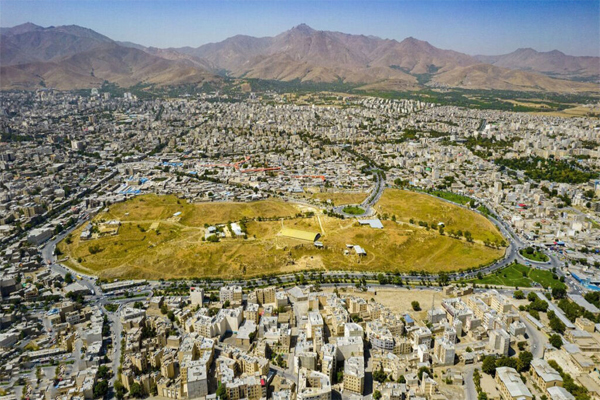
Located in the modern city of Hamadan, Hegmataneh (ancient Ecbatana) is one of the oldest urban settlements in Iran and one of the most important archaeological sites in the Middle East. According to historical sources, the city was founded in the 7th century BC by Deioces, the first king of the Median Empire, making it the earliest known capital of the Medes.
Throughout its long history, Hegmataneh remained a significant political and administrative center during the Median, Achaemenid, Seleucid, Parthian, and Sasanian periods. It later continued to flourish during the Islamic era, reflecting more than 2,700 years of continuous urban development.
Archaeological excavations have revealed a remarkably planned ancient city featuring regular streets, residential quarters, fortification walls, workshops, drainage systems, and numerous historical artifacts. The site also includes important monuments such as the Hegmataneh Museum, the Church of Gregory the Illuminator, and the nearby Tomb of Avicenna (Ibn Sina), making Hamadan one of Iran's richest cultural destinations.
Recognizing its exceptional testimony to early urban planning and its importance in the history of Iranian civilization, UNESCO inscribed Hegmataneh on the World Heritage List in 2024.
Today, Hegmataneh offers visitors an extraordinary opportunity to explore the origins of one of the world's earliest kingdoms while discovering thousands of years of Iranian history preserved beneath the modern city.
Why Visit Hegmataneh?
✔ Capital of the ancient Median Empire
✔ UNESCO World Heritage Site since 2024
✔ More than 2,700 years of history
✔ One of Iran's oldest archaeological cities
✔ Close to the Tomb of Avicenna and other historic attractions
Best Time to Visit
The best time to visit Hamadan is May to September, when the mountain climate is cool and ideal for exploring archaeological sites.
Quick Information
📍 Location: Hamadan Province
🏛 Category: Cultural Heritage
📅 UNESCO Inscription: 2024
👑 Founded: 7th Century BC
⏳ Historical Period: Median, Achaemenid, Parthian, Sasanian & Islamic
⏱ Recommended Visit: 2–3 Hours
🚗 Nearby Attractions: Tomb of Avicenna, Alavian Dome, Ganjnameh
04. Pasargadae
UNESCO World Heritage Site (2004)
Pasargadae – The First Capital of the Achaemenid Empire and the Tomb of Cyrus the Great
Located in the plains of Fars Province, near the city of Shiraz, Pasargadae was the first dynastic capital of the Achaemenid Empire and one of the most important archaeological sites of ancient Iran. Inscribed on the UNESCO World Heritage List in 2004, Pasargadae represents the beginning of one of the greatest empires in human history and preserves the legacy of its founder, Cyrus the Great.
The city was established around 550 BC by Cyrus the Great after his victory over the Median Empire and the foundation of the Achaemenid dynasty. Unlike many ancient capitals built mainly for defense, Pasargadae was designed as an open royal landscape that combined palaces, gardens, ceremonial spaces, and monumental architecture in harmony with nature.
The most famous monument of Pasargadae is the Tomb of Cyrus the Great, a simple yet powerful stone structure that has survived for more than 2,500 years. Built from large limestone blocks, the tomb reflects the architectural style of the early Achaemenid period and remains one of the most recognizable symbols of Persian history.
Beyond the tomb, the archaeological complex includes several important structures such as the Gate of Pasargadae, the Audience Hall, the Private Palace of Cyrus, and the remains of royal gardens. These elements demonstrate the early development of the Persian Garden concept, where water channels, vegetation, and architecture were carefully integrated to create a harmonious environment.
Pasargadae also reflects the unique vision of Cyrus the Great, whose rule was known for administrative innovation, respect for different cultures, and the creation of a vast multicultural empire. The ideas developed during this period influenced Persian governance and architecture for centuries.
The design of Pasargadae introduced many features that later became characteristic of Persian architecture, including monumental stone construction, planned gardens, and the combination of natural landscapes with royal spaces. Its influence can be seen in later Persian sites such as Persepolis and other historic gardens across Iran.
Today, Pasargadae offers visitors a chance to explore the origins of the Achaemenid Empire and experience one of the most important places connected to the history of ancient Persia. Standing beside the Tomb of Cyrus and walking through the remains of the royal complex provides a powerful connection to one of the earliest chapters of Persian civilization.
Why Visit Pasargadae?
✔ The first capital of the Achaemenid Empire
✔ UNESCO World Heritage Site since 2004
✔ Home to the Tomb of Cyrus the Great
✔ One of the earliest examples of Persian garden design
✔ A key site for understanding the origins of Persian civilization
✔ Located near Persepolis and Naqsh-e Rostam
Best Time to Visit
The best time to visit Pasargadae is during spring (March to May) and autumn (September to November) when the weather in Fars Province is mild and ideal for outdoor exploration.
Morning and late afternoon visits are recommended, especially for photography and avoiding midday heat.
Quick Information
📍 Location: Fars Province, near Shiraz
🏛 Category: Cultural Heritage
📅 UNESCO Inscription: 2004
👑 Founded By: Cyrus the Great
⏳ Historical Period: Achaemenid Empire (6th Century BC)
🏗 Main Features: Tomb of Cyrus the Great, Royal Palaces, Persian Gardens
⏱ Recommended Visit: 1–2 Hours
🚗 Nearby Attractions: Persepolis, Naqsh-e Rostam, Shiraz Historic Sites

05. Persepolis – The Ceremonial Capital of the Achaemenid Empire
Rising from the plains of Fars Province, Persepolis stands as one of the greatest archaeological treasures of the ancient world and the most iconic symbol of the Achaemenid Empire (550–330 BC). Founded by King Darius I around 518 BC and later expanded by Xerxes I and Artaxerxes I, Persepolis served as the magnificent ceremonial capital of the Persian Empire—the largest empire of its time, stretching across three continents.
Rather than functioning as an ordinary administrative city, Persepolis was designed as a grand ceremonial complex where representatives from across the empire gathered to celebrate Nowruz (Persian New Year) and present tribute to the King of Kings. The monumental terraces, palaces, gateways, audience halls, royal treasury, and exquisite stone reliefs reflect the political power, artistic excellence, and cultural diversity of ancient Persia.
Among the site's most famous monuments are the Gate of All Nations, the Apadana Palace, the Hall of One Hundred Columns, the Tripylon, the Royal Treasury, and the magnificent royal tombs carved into the nearby cliffs of Naqsh-e Rostam. The beautifully carved reliefs depicting delegates from more than twenty nations symbolize the unity, tolerance, and multicultural nature of the Achaemenid Empire.
In 330 BC, Persepolis was partially destroyed following the invasion of Alexander the Great, yet its monumental ruins remain one of the world's most remarkable archaeological sites. UNESCO recognized Persepolis as one of its very first World Heritage Sites in 1979, acknowledging its outstanding universal value and its profound influence on architecture, art, and human civilization.
Today, Persepolis is Iran's most visited archaeological site and one of the country's greatest cultural treasures, attracting travelers, historians, archaeologists, and photographers from around the world.
Why Visit Persepolis?
✔ Iran's most famous archaeological site
✔ UNESCO World Heritage Site since 1979
✔ Ceremonial capital of the Achaemenid Empire
✔ Extraordinary stone carvings and monumental architecture
✔ One of the greatest ancient cities in world history
✔ Located near Naqsh-e Rostam and Pasargadae
Best Time to Visit
The best time to visit Persepolis is March to May and October to November, when temperatures are pleasant for walking around the vast archaeological complex. Early morning and late afternoon offer the best light for photography.
Quick Information
📍 Location: Marvdasht, Fars Province
🏛 Category: Cultural Heritage
📅 UNESCO Inscription: 1979
👑 Founded By: Darius the Great
⏳ Historical Period: Achaemenid Empire (6th–4th Century BC)
⏱ Recommended Visit: 3–4 Hours
🚗 Distance from Shiraz: Approximately 60 km
📸 Nearby Attractions: Naqsh-e Rostam, Naqsh-e Rajab, Pasargadae

06. Bisotun (Behistun)
UNESCO World Heritage Site (2006)
Bisotun – The Monumental Inscription of Darius the Great
Located in Kermanshah Province in western Iran, Bisotun (Behistun) is one of the most important historical sites from the ancient Persian period. Inscribed on the UNESCO World Heritage List in 2006, Bisotun is famous for its extraordinary rock relief and multilingual inscription created by Darius the Great, one of the most influential kings of the Achaemenid Empire.
The monument is carved into a massive limestone cliff along an ancient trade route that connected Mesopotamia with the Iranian plateau. For thousands of years, this strategic location served as a meeting point between different cultures, civilizations, and travelers.
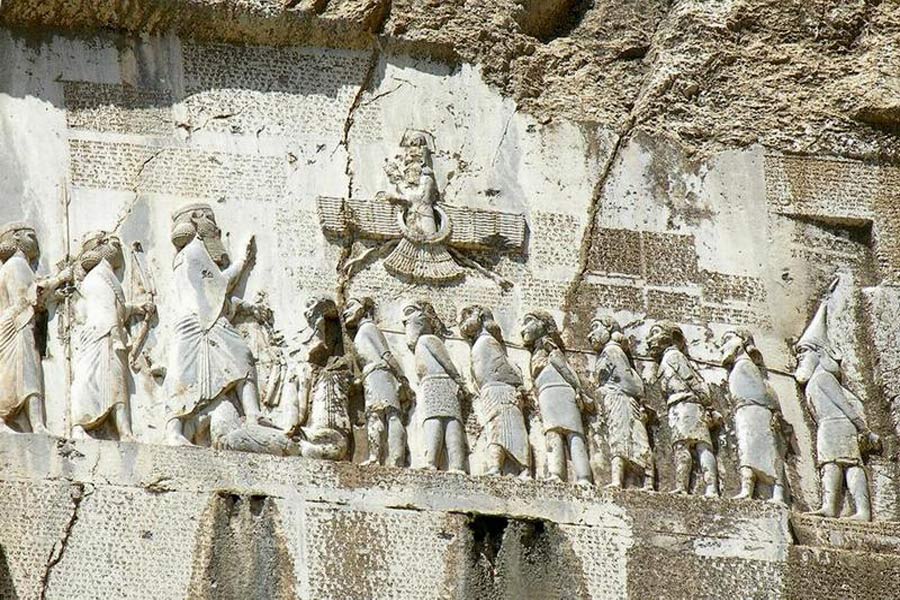
The most remarkable feature of Bisotun is the Behistun Inscription, created around 520 BC by order of Darius the Great shortly after he became king. Written in three ancient languages — Old Persian, Elamite, and Babylonian — the inscription describes Darius’s rise to power, his victories over rebellions, and the legitimacy of his rule.
The inscription played a crucial role in modern archaeology because its parallel texts helped scholars decipher ancient cuneiform writing, similar to the importance of the Rosetta Stone for Egyptian hieroglyphs. This discovery opened a new chapter in the understanding of ancient Persian and Mesopotamian civilizations.
Above the inscription is a remarkable rock relief showing Darius the Great standing over defeated enemies, accompanied by Persian soldiers and the symbolic figure of Ahuramazda, representing divine support in Achaemenid ideology. The artwork provides valuable information about Persian royal traditions, clothing, military organization, and political beliefs.
However, Bisotun’s importance extends beyond the Achaemenid period. Archaeological evidence shows that the area remained significant for thousands of years, with remains from prehistoric times, the Median period, the Seleucid era, the Parthian period, the Sassanid era, and later Islamic centuries.
The surrounding landscape of Bisotun adds to its cultural value. Located at the foot of the Zagros Mountains, the site combines natural beauty with historical significance, creating a unique cultural landscape where ancient history and nature exist together.
Today, Bisotun is considered one of the greatest historical documents of ancient Persia. Visiting the site allows travelers to discover not only the achievements of Darius the Great but also the story of how ancient civilizations recorded their history and preserved their identity for future generations.
Why Visit Bisotun?
✔ Home to the famous inscription of Darius the Great
✔ UNESCO World Heritage Site since 2006
✔ One of the most important sources for understanding Achaemenid history
✔ The key to deciphering ancient Persian cuneiform inscriptions
✔ A unique combination of archaeology, history, and natural landscape
✔ Located along an ancient route connecting Persia and Mesopotamia
Best Time to Visit
The best time to visit Bisotun is during spring (April to June) and autumn (September to November) when the weather in Kermanshah is comfortable for exploring outdoor archaeological sites.
Spring is especially beautiful due to the green landscapes surrounding the Zagros Mountains.
Quick Information
📍 Location: Kermanshah Province
🏛 Category: Cultural Heritage
📅 UNESCO Inscription: 2006
👑 Created By: Darius the Great
⏳ Historical Period: Achaemenid Empire (6th Century BC)
🏗 Main Feature: Behistun Inscription and Rock Relief
⏱ Recommended Visit: 1–2 Hours
🚗 Nearby Attractions: Taq-e Bostan, Kermanshah Historic Bazaar, Anahita Temple of Kangavar
07. Takht-e Soleyman
UNESCO World Heritage Site (2003)
Takht-e Soleyman – The Sacred Sanctuary of Fire and Water
Nestled within a volcanic valley in West Azerbaijan Province, Takht-e Soleyman is one of Iran's most mysterious and spiritually significant archaeological sites. Once the principal sanctuary of the Sasanian Empire, this remarkable complex was dedicated to Atash Adur Gushnasp, one of the three Great Fires of Zoroastrianism. At its center lies a stunning natural lake, formed by a deep artesian spring, which has been revered for thousands of years.
The site combines the remains of a magnificent Zoroastrian fire temple, royal palaces, defensive walls, and later Ilkhanid-period structures, all harmoniously integrated into the surrounding volcanic landscape. Takht-e Soleyman illustrates the close relationship between nature, religion, and royal power in ancient Persia. Its architectural layout and symbolic importance also influenced later Islamic architecture across the region.
Recognizing its exceptional historical, religious, and architectural value, UNESCO inscribed Takht-e Soleyman on the World Heritage List in 2003. Today, it remains one of Iran's most fascinating destinations for travelers interested in archaeology, ancient religions, and Persian history.
Why Visit Takht-e Soleyman?
✔ One of the most sacred Zoroastrian sites in the world
✔ Spectacular volcanic lake surrounded by ancient ruins
✔ UNESCO World Heritage Site since 2003
✔ Outstanding Sasanian royal architecture
✔ A unique blend of history, mythology, and breathtaking natural scenery
Best Time to Visit
The best time to visit Takht-e Soleyman is late spring through early autumn (May–October), when the mountain climate is mild and ideal for exploring the archaeological site.
Quick Information
📍 Location: West Azerbaijan Province
🏛 Category: Cultural Heritage
📅 UNESCO Inscription: 2003
⏳ Historical Period: Sasanian Empire (3rd–7th Century AD)
⏱ Recommended Visit: 2–3 hours
🚗 Nearest City: Takab (approximately 45 km)

08. Sassanid Archaeological Landscape of Fars Region
UNESCO World Heritage Site (2018)
Sassanid Archaeological Landscape of Fars Region – The Legacy of the Last Great Persian Empire Before Islam
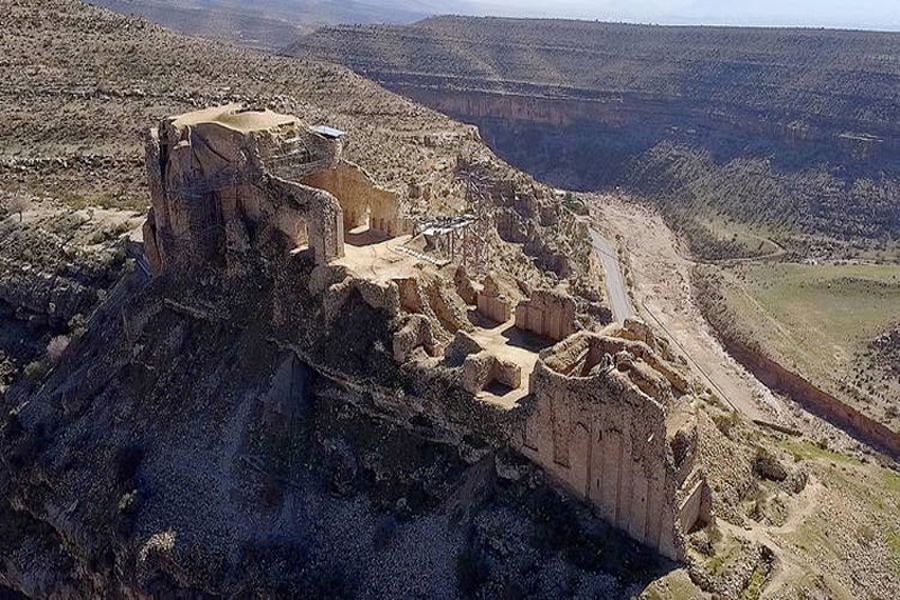
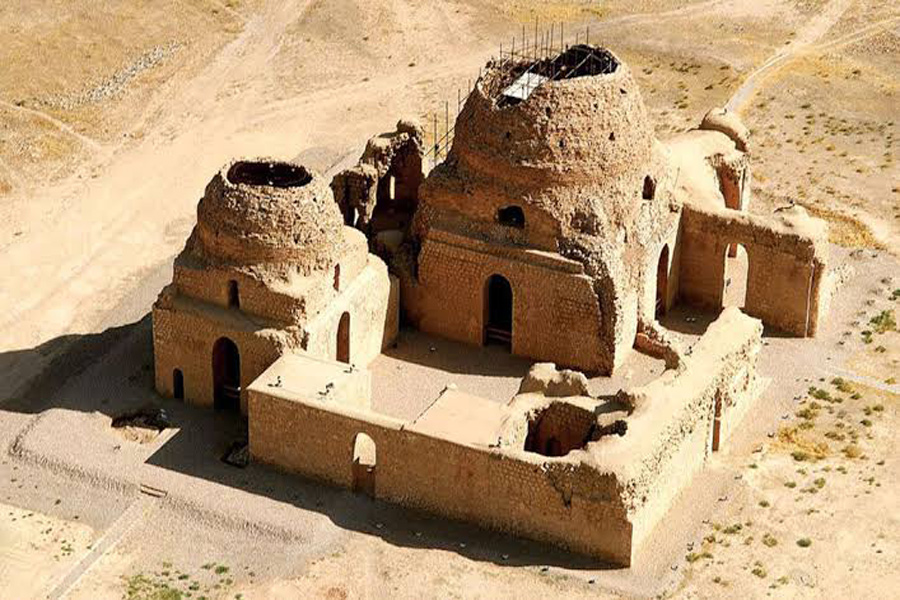
Located in Fars Province in southern Iran, the Sassanid Archaeological Landscape of Fars Region represents one of the most important chapters of Persian history. Inscribed on the UNESCO World Heritage List in 2018, this collection of eight archaeological sites preserves the remains of the Sassanid Empire (224–651 CE), the last great Persian empire before the arrival of Islam.
The Sassanids created a powerful civilization that played a major role in the political, cultural, and artistic history of the ancient world. Their empire extended across a vast territory from Mesopotamia to Central Asia and stood as one of the two great powers of late antiquity alongside the Roman and Byzantine Empires.
The UNESCO-listed landscape includes sites in three historic areas of Fars Province:
Firuzabad
Bishapur
Sarvestan
Together, these sites demonstrate the advanced urban planning, military architecture, royal traditions, and artistic achievements of the Sassanid period.
Firuzabad – The Birthplace of the Sassanid Empire
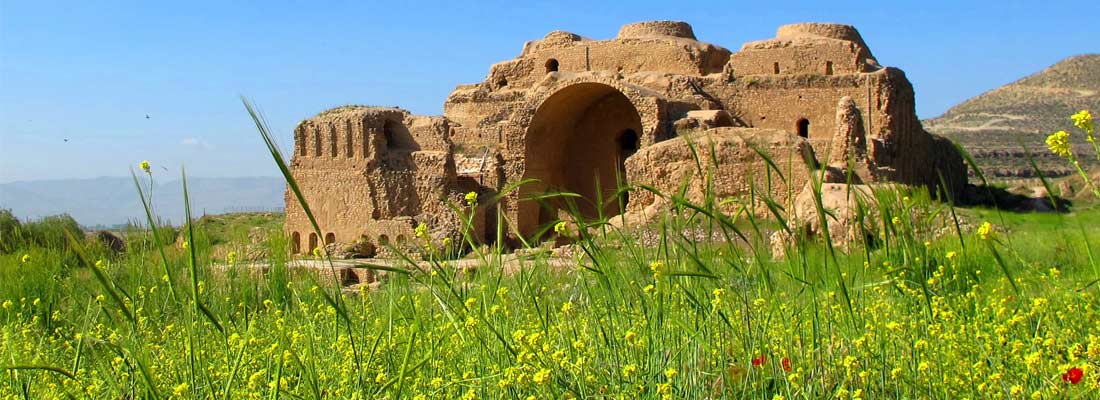
The ancient city of Firuzabad was founded by Ardashir I, the founder of the Sassanid dynasty, after his victory over the Parthian Empire in the 3rd century CE.
The circular city of Ardashir-Khwarrah is one of the earliest examples of planned urban design in Iran. Its unique circular layout reflects advanced knowledge of architecture, astronomy, and city planning.
Nearby monuments such as the Palace of Ardashir and the Qal'eh Dokhtar Fortress demonstrate the power and architectural style of the early Sassanid rulers.
Bishapur – A City of Persian and Roman Influences
Founded by Shapur I around 266 CE, Bishapur was one of the most remarkable cities of the Sassanid era.The city reflects a fascinating combination of Persian and Roman artistic traditions. After defeating the Roman Emperor Valerian, Shapur I brought Roman craftsmen and influences into Bishapur, creating a unique cultural blend.
The site includes:
The ancient city layout
The royal palace complex
The Temple of Anahita
Remarkable stone mosaics
Nearby rock reliefs showing Sassanid kings
Bishapur represents the cultural exchange that existed between Persia and the Mediterranean world during late antiquity.

Sarvestan – A Masterpiece of Sassanid Architecture
The Sarvestan Palace is one of the most significant surviving examples of late Sassanid architecture.
Built with stone and brick, the palace demonstrates important architectural innovations, including large domes, vaulted halls, and structural techniques that later influenced Islamic architecture in Iran.
A Bridge Between Ancient Persia and Islamic Iran
The importance of the Sassanid Archaeological Landscape extends beyond the Sassanid period itself. Many architectural elements developed during this era — including domes, iwans, and palace designs — became fundamental features of Persian Islamic architecture in later centuries.
These sites show the continuity of Persian civilization and explain how ancient Iranian traditions continued to influence Iran’s cultural identity after the transformation of the 7th century.
Today, visiting the Sassanid archaeological sites of Fars offers travelers a unique opportunity to explore the final chapter of ancient Persia and understand the foundations that shaped later Iranian architecture and culture.
Why Visit Sassanid Archaeological Landscape?
✔ UNESCO World Heritage Site since 2018
✔ Represents the last great Persian Empire before Islam
✔ Includes ancient cities, palaces, fortresses, and rock reliefs
✔ Shows the evolution of Persian architecture and urban planning
✔ Combines Persian, Roman, and regional cultural influences
✔ A key destination for understanding Iran’s historical continuity
Best Time to Visit
The best time to visit the Sassanid sites of Fars is from October to April, when the southern Iranian climate is cooler and ideal for exploring archaeological landscapes.
Spring is especially recommended for visiting Firuzabad and Bishapur due to the beautiful natural surroundings.
Quick Information
📍 Location: Fars Province (Firuzabad, Bishapur, Sarvestan)
🏛 Category: Cultural Heritage
📅 UNESCO Inscription: 2018
👑 Historical Period: Sassanid Empire (224–651 CE)
🏗 Main Features: Ardashir-Khwarrah, Palace of Ardashir, Bishapur, Temple of Anahita, Sarvestan Palace
⏱ Recommended Visit: 1–2 Days
🚗 Nearby Attractions: Shiraz, Persepolis, Pasargadae, Naqsh-e Rostam
Chapter 02
Islamic Cities and Royal Architecture
The SPlendor of Persian-Islamic Heritage
09. Meidan Imam (Naqsh-e Jahan Square)
UNESCO World Heritage Site (1979)
Meidan Imam (Naqsh-e Jahan Square) – Masterpiece of Safavid Urban Planning
Located in the heart of Isfahan, Meidan Imam—historically known as Naqsh-e Jahan Square—is one of the largest and most magnificent public squares ever built. Constructed in the early 17th century under Shah Abbas I, it became the political, commercial, religious, and cultural center of the Safavid Empire.
The square is surrounded by four iconic monuments: Imam Mosque, Sheikh Lotfollah Mosque, Ali Qapu Palace, and the entrance to the Grand Bazaar of Isfahan. Together, these masterpieces showcase the finest achievements of Persian architecture, Islamic art, urban planning, and tilework.
Inscribed on the UNESCO World Heritage List in 1979, Meidan Imam remains one of Iran's most celebrated landmarks. Today, visitors can admire its timeless architecture, vibrant atmosphere, traditional bazaars, horse-drawn carriages, and beautiful gardens, making it one of the country's most unforgettable cultural destinations.
Why Visit Meidan Imam?
✔ One of the largest historic squares in the world
✔ Home to four UNESCO-recognized masterpieces
✔ Outstanding example of Safavid architecture
✔ Vibrant traditional bazaar and cultural atmosphere
✔ The symbol of historic Isfahan
Best Time to Visit
The best seasons to visit are spring (March–May) and autumn (September–November) when Isfahan enjoys comfortable temperatures.
Quick Information
📍 Location: Isfahan Province
🏛 Category: Cultural Heritage
📅 UNESCO Inscription: 1979
⏳ Historical Period: Safavid Dynasty (17th Century)
⏱ Recommended Visit: 3–4 hours
🚶 Nearby Attractions: Imam Mosque, Sheikh Lotfollah Mosque, Ali Qapu Palace, Isfahan Grand Bazaar

10. Masjed-e Jame of Isfahan (Jameh mosque of Isfahan)
UNESCO World Heritage Site (2012)
Jameh Mosque of Isfahan – A Thousand Years of Persian Islamic Architecture
Located in the heart of the historic city of Isfahan, the Jameh Mosque of Isfahan is one of the oldest and most influential mosques in the Islamic world. With a history spanning more than twelve centuries, the mosque reflects the evolution of Persian-Islamic architecture from the 8th century through the Seljuk, Ilkhanid, Timurid, Safavid, and Qajar periods.
Unlike many historic monuments built during a single era, the Jameh Mosque developed continuously over centuries. Every dynasty added new architectural elements, creating a remarkable collection of domes, iwans, courtyards, prayer halls, minarets, stucco decorations, brickwork, and tile mosaics. The mosque is widely recognized as the earliest and finest example of the four-iwan mosque plan, a design that later became the standard for mosque architecture throughout Iran, Central Asia, and beyond.
UNESCO inscribed the Jameh Mosque of Isfahan on the World Heritage List in 2012, recognizing it as an architectural masterpiece and a living record of more than a thousand years of Islamic art and engineering. Today, it remains one of Iran's most important religious and historical landmarks.
Why Visit Jameh Mosque of Isfahan?
✔ More than 1,200 years of architectural history
✔ Birthplace of the Four-Iwan mosque design
✔ UNESCO World Heritage Site since 2012
✔ Masterpiece of Persian brick architecture
✔ One of the most important Islamic monuments in the world
Best Time to Visit
The best time to visit Isfahan is March to May and September to November, when the weather is mild and comfortable for sightseeing.
Quick Information
📍 Location: Isfahan Province
🏛 Category: Cultural Heritage
📅 UNESCO Inscription: 2012
⏳ Historical Period: 8th–20th Century
⏱ Recommended Visit: 2 hours
🚶 Location: Historic Center of Isfahan

11. Golestan Palace
UNESCO World Heritage Site (2013)
Golestan Palace – The Royal Jewel of Qajar Tehran
Located in the historic heart of Tehran, Golestan Palace is one of Iran’s most magnificent royal complexes and a masterpiece of Qajar architecture. Inscribed on the UNESCO World Heritage List in 2013, the palace reflects more than four centuries of Persian art, architecture, and royal history while showcasing the cultural exchange between traditional Persian craftsmanship and European influences.
The origins of Golestan Palace date back to the Safavid period (16th century), when a royal citadel was first established in Tehran. However, the complex reached its greatest splendor during the Qajar dynasty (1789–1925), when Tehran became the capital of Iran and Golestan Palace served as the official residence and ceremonial center of the Qajar kings.
The palace is renowned for its harmonious blend of Persian architectural traditions with European artistic styles introduced during the 19th century. Elegant mirror halls, colorful tilework, marble terraces, richly decorated reception rooms, and beautifully landscaped gardens create a unique royal atmosphere unlike any other monument in Iran.
Among its most famous buildings are the Marble Throne Hall (Takht-e Marmar), where Qajar kings were crowned, and the spectacular Hall of Mirrors, immortalized in the famous painting by Iranian master Kamal-ol-Molk. Other highlights include the Shams-ol-Emareh, one of Tehran’s earliest high-rise buildings, and several museums displaying royal gifts, paintings, manuscripts, ceramics, and historical artifacts.
Golestan Palace also witnessed many of the most important events in modern Iranian history, including royal coronations, diplomatic ceremonies, and official state receptions. Its architecture reflects the transformation of Iran during the 19th century as Persian traditions met new artistic ideas from Europe.
Today, Golestan Palace remains one of Tehran’s most visited cultural attractions, offering visitors an opportunity to experience the elegance of the Qajar royal court while exploring one of the finest examples of Persian palace architecture.
Why Visit Golestan Palace?
✔ UNESCO World Heritage Site since 2013
✔ Masterpiece of Qajar royal architecture
✔ Home to the famous Hall of Mirrors and Marble Throne
✔ Stunning Persian gardens, tilework, and mirror decorations
✔ Rich museums displaying royal treasures and historical collections
✔ Located in the historic center of Tehran
Best Time to Visit
The best time to visit Golestan Palace is during spring (March to May) and autumn (September to November), when Tehran enjoys pleasant weather and the palace gardens are especially beautiful.
Morning visits are recommended for comfortable temperatures and better photography.
Quick Information
📍 Location: Tehran Province, Tehran
🏛 Category: Cultural Heritage
📅 UNESCO Inscription: 2013
👑 Historical Period: Safavid origins, Qajar Dynasty (18th–20th Century)
🏰 Main Features: Marble Throne Hall, Hall of Mirrors, Shams-ol-Emareh, Royal Gardens, Museums
⏱ Recommended Visit: 2–3 Hours
🚗 Nearby Attractions: Grand Bazaar of Tehran, National Museum of Iran, Imam Khomeini Square

12. Historic City of Yazd
UNESCO World Heritage Site (2017)
Historic City of Yazd – The World's Largest Living Adobe City
Situated in the heart of the Iranian Plateau, Yazd is one of the oldest continuously inhabited cities in the world and the largest living adobe city on Earth. For more than two thousand years, the people of Yazd have successfully adapted to the harsh desert climate through remarkable innovations in architecture, water management, and urban planning.
The city's distinctive skyline is defined by its famous windcatchers (Badgirs), elegant domes, mud-brick houses, narrow shaded alleyways, and an extensive underground qanat system that has supplied water for centuries. These sustainable architectural solutions created a comfortable urban environment despite the extreme desert temperatures and continue to inspire environmentally conscious design today.
Yazd is also recognized as one of the world's most important centers of Zoroastrian heritage. Landmarks such as the Jameh Mosque of Yazd, the Amir Chakhmaq Complex, the Zoroastrian Fire Temple, and the nearby Towers of Silence reflect the city's rich religious and cultural diversity.
UNESCO inscribed the Historic City of Yazd on the World Heritage List in 2017, recognizing it as an outstanding example of traditional human settlement and one of the finest examples of desert architecture anywhere in the world.
Today, Yazd offers visitors a unique opportunity to experience authentic Persian culture, traditional courtyard houses, boutique hotels, ancient bazaars, and one of Iran's most atmospheric historic cities.
Why Visit Yazd?
✔ The world's largest living adobe city
✔ Famous for traditional windcatchers (Badgirs)
✔ UNESCO World Heritage Site since 2017
✔ Outstanding example of sustainable desert architecture
✔ Center of Zoroastrian culture and history
Best Time to Visit
The best time to visit Yazd is March to May and October to November, when temperatures are pleasant for exploring the old city.
Quick Information
📍 Location: Yazd Province
🏛 Category: Cultural Heritage
📅 UNESCO Inscription: 2017
⏳ Historical Period: From the Sasanian Era to the Present
⏱ Recommended Visit: Full Day (4–8 hours)
🚶 Highlights: Windcatchers, Qanats, Jameh Mosque, Amir Chakhmaq, Zoroastrian Fire Temple

13. Soltaniyeh Dome
UNESCO World Heritage Site (2005)
Soltaniyeh – Home to One of the World's Largest Brick Domes
Located in Zanjan Province, Soltaniyeh was the capital of the Ilkhanid Dynasty during the 14th century and is home to the magnificent Dome of Soltaniyeh, one of the largest brick domes ever constructed. Built between 1302 and 1312 AD under the reign of Sultan Öljeitü (Oljeitu), this masterpiece represents one of the greatest achievements of Persian-Islamic architecture.
Standing approximately 50 meters high with a double-shell structure, the dome was an extraordinary engineering accomplishment for its time. Its elegant turquoise-tiled exterior, intricate stucco decorations, colorful wall paintings, and harmonious proportions influenced the development of later Islamic architecture, including some of the great domes of Central Asia and even the Renaissance period.
UNESCO inscribed Soltaniyeh on the World Heritage List in 2005 as an outstanding example of Ilkhanid architecture and one of the finest monuments of Persian engineering. Today, the city remains one of Iran's most remarkable historical destinations, attracting visitors interested in architecture, history, and Islamic art.
Why Visit Soltaniyeh?
✔ One of the world's largest brick domes
✔ Masterpiece of Ilkhanid architecture
✔ UNESCO World Heritage Site since 2005
✔ Spectacular turquoise dome and interior decorations
✔ One of the greatest engineering achievements of medieval Persia
Best Time to Visit
The best time to visit Soltaniyeh is April to October, when the weather in northwestern Iran is mild and comfortable.
Quick Information
📍 Location: Zanjan Province
🏛 Category: Cultural Heritage
📅 UNESCO Inscription: 2005
⏳ Historical Period: Ilkhanid Dynasty (14th Century)
⏱ Recommended Visit: 1.5–2 hours
🚗 Distance from Zanjan: Approximately 40 km
.jpg "Soltaniyeh Dome. A UNESCO world heritage site in Iran.")
14.Gonbad-e Qabus (Qabus Tower)
UNESCO World Heritage Site (2012)
Gonbad-e Qabus – The Tallest Brick Tower of the Ancient World
Located in the city of Gonbad-e Qabus in Golestan Province, northern Iran, the Gonbad-e Qabus is one of the greatest achievements of early Islamic architecture and the tallest surviving brick tower in the world. Inscribed on the UNESCO World Heritage List in 2012, this remarkable monument represents the scientific knowledge, architectural innovation, and artistic excellence of the Ziyarid dynasty during the 11th century.
Built in 1006–1007 CE by Qabus ibn Wushmgir, ruler of the Ziyarid dynasty, the tower was constructed as a monumental landmark and possibly as a funerary monument for the ruler himself. Rising approximately 53 meters above the ground, Gonbad-e Qabus demonstrates extraordinary precision in engineering and remains one of the most impressive brick structures ever created.
The tower has a unique cylindrical shape with a ten-pointed star-shaped plan and a conical roof. Its simple yet powerful design is based on mathematical proportions, creating a perfect harmony between height, structure, and decoration. The exterior walls are decorated with two Kufic inscriptions that provide historical information about the builder and the date of construction.
Unlike many later Islamic monuments decorated with colorful tiles and elaborate ornaments, Gonbad-e Qabus represents the beauty of pure brick architecture. Its carefully arranged brick patterns, geometric forms, and monumental scale reflect the creativity of Persian architects during the early Islamic period.
The tower stands as a symbol of Iran’s long tradition of scientific and architectural achievements. Its innovative design influenced the development of tower architecture across the Islamic world and inspired later monuments throughout Persia and Central Asia.
Today, Gonbad-e Qabus is one of Iran’s most important historical attractions and a must-visit destination for travelers interested in Persian architecture, ancient engineering, and the cultural heritage of northern Iran.
Why Visit Gonbad-e Qabus?
✔ UNESCO World Heritage Site since 2012
✔ The tallest surviving brick tower in the world
✔ A masterpiece of 11th-century Persian-Islamic architecture
✔ Built during the Ziyarid dynasty over 1,000 years ago
✔ Outstanding example of mathematical and engineering knowledge
✔ Unique geometric design and Kufic inscriptions
Best Time to Visit
The best time to visit Gonbad-e Qabus is during spring (March to May) and autumn (September to November), when the weather in Golestan Province is mild and pleasant.
Sunset and early morning visits are highly recommended, as the changing light creates beautiful views of the brick structure and surrounding landscape.
Quick Information
📍 Location: Gonbad-e Qabus, Golestan Province, Iran
🏛 Category: Cultural Heritage
📅 UNESCO Inscription: 2012
👑 Historical Period: Ziyarid Dynasty (11th Century)
🏰 Main Features: Cylindrical brick tower, conical roof, Kufic inscriptions, geometric architecture
📏 Height: Approximately 53 meters
⏱ Recommended Visit: 1–2 Hours
🚗 Nearby Attractions: Gonbad-e Qabus city, Turkmen cultural areas, Golestan Province natural landscapes

15. Sheikh Safi al-Din Khānegāh and Shrine Ensemble in Ardabil
UNESCO World Heritage Site (2010)
Sheikh Safi al-Din Khānegāh and Shrine Ensemble – A Masterpiece of Persian Sufi Architecture
Located in the historic city of Ardabil in northwestern Iran, the Sheikh Safi al-Din Khānegāh and Shrine Ensemble is one of the finest examples of Persian Islamic architecture and an outstanding monument of Sufism. Built between the 14th and 18th centuries, the complex was established around the tomb of Sheikh Safi al-Din Ardabili (1252–1334), the revered Sufi master and spiritual ancestor of the Safavid dynasty.
Designed according to the mystical concept of the Seven Stages of Sufism, the complex includes a mausoleum, mosque, prayer hall, library, school, courtyards, gardens, bathhouse, and ceremonial spaces. Its elegant brickwork, exquisite tile mosaics, intricate calligraphy, wooden craftsmanship, and harmonious architectural layout reflect the artistic achievements of Persian civilization during the Safavid period.
UNESCO inscribed the Sheikh Safi al-Din Khānegāh and Shrine Ensemble on the World Heritage List in 2010, recognizing its exceptional architectural, artistic, religious, and historical significance. Today, the site remains one of Iran's most important pilgrimage destinations and a remarkable cultural landmark that attracts visitors interested in Islamic art, architecture, and history.
Why Visit Sheikh Safi al-Din Shrine?
✔ Outstanding masterpiece of Persian Islamic architecture
✔ Spiritual center of the Safavid dynasty
✔ UNESCO World Heritage Site since 2010
✔ Beautiful tilework, calligraphy, and historic courtyards
✔ One of the most important Sufi monuments in the Islamic world
Best Time to Visit
The best time to visit Ardabil is May to September, when the region enjoys mild temperatures and pleasant weather.
Quick Information
📍 Location: Ardabil Province
🏛 Category: Cultural Heritage
📅 UNESCO Inscription: 2010
⏳ Historical Period: 14th–18th Century (Ilkhanid to Safavid)
⏱ Recommended Visit: 2 hours
🚶 Location: Historic center of Ardabil

16. Armenian Monastic Ensembles of Iran
UNESCO World Heritage Site (2008)
Armenian Monastic Ensembles of Iran – A Unique Heritage of Faith, Architecture, and Cultural Exchange
Located in the northwest of Iran, in the provinces of West Azerbaijan and East Azerbaijan, the Armenian Monastic Ensembles of Iran represent one of the most remarkable examples of Armenian religious architecture outside Armenia. Inscribed on the UNESCO World Heritage List in 2008, this heritage site includes three historic Armenian monasteries that reflect centuries of cultural interaction between Armenian, Persian, and regional civilizations.
The three monasteries included in this UNESCO site are:
• St. Thaddeus Monastery (Qara Kelisa) – one of the oldest Christian monasteries in the world, located near Chaldoran in West Azerbaijan Province.
• Saint Stepanos Monastery – a magnificent medieval monastery situated in a beautiful valley near Jolfa in East Azerbaijan Province.
• Chapel of Dzordzor – a small but historically significant Armenian chapel located near Maku in West Azerbaijan Province.
These monuments were important centers of Armenian Christianity, education, art, and cultural exchange for more than a thousand years. They served not only as religious sites but also as places where manuscripts were created, knowledge was preserved, and artistic traditions were developed.
The architecture of the Armenian Monastic Ensembles combines Armenian religious traditions with local Persian influences. Their stone walls, decorative carvings, domed structures, and detailed architectural elements demonstrate the exceptional craftsmanship of Armenian builders and artists throughout history.
St. Thaddeus Monastery, also known as Qara Kelisa (Black Church), is traditionally believed to have been founded on the site where Saint Thaddeus, one of the apostles of Jesus Christ, was martyred. Every year, Armenian pilgrims from Iran and around the world gather here for religious ceremonies and cultural celebrations.
Saint Stepanos Monastery, surrounded by mountains and the Aras River landscape, is famous for its impressive stone architecture, artistic decorations, and peaceful natural setting. It represents one of the finest examples of medieval Armenian architecture in the region.
The Armenian Monastic Ensembles of Iran symbolize religious tolerance, cultural diversity, and the long history of coexistence between different communities in Iran. Today, they are among Iran’s most important cultural attractions and offer visitors a unique journey through history, architecture, and spirituality.
Why Visit Armenian Monastic Ensembles of Iran?
✔ UNESCO World Heritage Site since 2008
✔ Three exceptional Armenian Christian monuments in Iran
✔ More than 1,000 years of religious and cultural history
✔ Outstanding examples of Armenian architecture and stone craftsmanship
✔ Beautiful mountain landscapes and historical surroundings
✔ Symbol of cultural exchange and peaceful coexistence
Best Time to Visit
The best time to visit the Armenian Monastic Ensembles is during spring (April to June) and autumn (September to October), when the weather is pleasant and the surrounding mountains and landscapes are at their most beautiful.
Visitors interested in cultural experiences may also consider visiting during the annual ceremonies at St. Thaddeus Monastery, when Armenian communities gather for religious celebrations.
Quick Information
📍 Location: West Azerbaijan and East Azerbaijan Provinces, Iran
🏛 Category: Cultural Heritage
📅 UNESCO Inscription: 2008
⛪ Historical Period: Early Christian Period to Medieval Armenian Era
🏰 Main Features: St. Thaddeus Monastery, Saint Stepanos Monastery, Chapel of Dzordzor
🌄 Landscape: Mountain valleys, Aras River region, northwest Iranian highlands
⏱ Recommended Visit: 1–2 Days
🚗 Nearby Attractions: Jolfa, Aras River, Chaldoran historical sites, Maku landscapes

Chapter 03
Persian Engineering & Cultural Landscapes
Innovation Through Water
17. Shushtar Historical Hydraulic System
UNESCO World Heritage Site (2009)
Shushtar Historical Hydraulic System – An Ancient Masterpiece of Water Engineering
Located in Khuzestan Province in southwestern Iran, the Shushtar Historical Hydraulic System is one of the most extraordinary examples of ancient water engineering in the world. Inscribed on the UNESCO World Heritage List in 2009, this complex represents the remarkable knowledge of Persian engineers who transformed a natural river system into an advanced network of canals, dams, tunnels, mills, and water distribution structures.Dating mainly from the Sassanid period (3rd–7th centuries CE), with earlier foundations from ancient times, the Shushtar hydraulic system demonstrates how engineering, agriculture, and urban development were closely connected in Persian civilization.
A City Designed Around Water
The city of Shushtar was built beside the Karun River, Iran’s largest and most important river. Ancient engineers developed a sophisticated system to control and redirect water flow, allowing the river to support agriculture, industries, and daily life.
The system includes:
Dams
Water diversion channels
Underground tunnels
Water mills
Bridges
Irrigation networks
Together, these structures created one of the most advanced hydraulic landscapes of the ancient world.
The Genius of Persian Engineering
The most remarkable part of the Shushtar system is the way ancient engineers worked with the natural landscape instead of against it.
The famous Band-e Kaisar (Caesar’s Dam), traditionally associated with Roman engineers captured during the wars between Persia and Rome, played an important role in regulating the river and supplying water to the city and surrounding agricultural lands.
The system also includes the Gargar Canal, an artificial waterway that redirected part of the Karun River and powered numerous water mills. These mills used the force of flowing water to support local industries and agricultural activities.
This combination of water management, energy production, and urban planning makes Shushtar a unique example of sustainable engineering.
Water, Agriculture, and Prosperity
The Shushtar hydraulic system allowed the surrounding region to become one of the most productive agricultural areas of ancient Persia.
Reliable water distribution supported the cultivation of:
Wheat
Barley
Sugar cane
Date palms
Other crops
The system demonstrates how Persian civilizations developed solutions for managing natural resources in challenging environments.
A Legacy That Survived Centuries
Although the system reached its greatest development during the Sassanid period, it continued to function throughout later historical periods, including the Islamic era.
Its survival for nearly two thousand years reflects the durability and intelligence of Persian engineering traditions.
Today, the Shushtar Historical Hydraulic System provides visitors with a unique opportunity to explore the relationship between architecture, technology, and nature. Standing beside its ancient canals and water structures, travelers can discover a remarkable achievement created by human creativity long before modern engineering.
Why Visit Shushtar Historical Hydraulic System?
✔ UNESCO World Heritage Site since 2009
✔ One of the greatest ancient water engineering achievements in the world
✔ A masterpiece of Sassanid-era technology
✔ Shows the connection between engineering, agriculture, and urban life
✔ One of Iran’s most unique cultural landscapes
✔ A rare example of ancient infrastructure still visible today
Best Time to Visit
The best time to visit Shushtar is from October to April, when the weather in Khuzestan is cooler and more comfortable for exploring outdoor historical sites.
Spring is especially beautiful, with pleasant temperatures and greener landscapes around the river.
Quick Information
📍 Location: Shushtar, Khuzestan Province
🏛 Category: Cultural Heritage / Engineering Heritage
📅 UNESCO Inscription: 2009
⏳ Historical Period: Mainly Sassanid Era (224–651 CE)
💧 Main Features: Dams, canals, tunnels, bridges, water mills, irrigation system
⚙️ Engineering Achievement: Ancient river management and water distribution network
⏱ Recommended Visit: 2–3 Hours
🚗 Nearby Attractions: Chogha Zanbil, Susa Ancient City, Haft Tappeh Archaeological Site

18.Persian Garden
UNESCO World Heritage Site (2011)
Persian Garden – A Symbol of Harmony Between Nature, Water, and Architecture
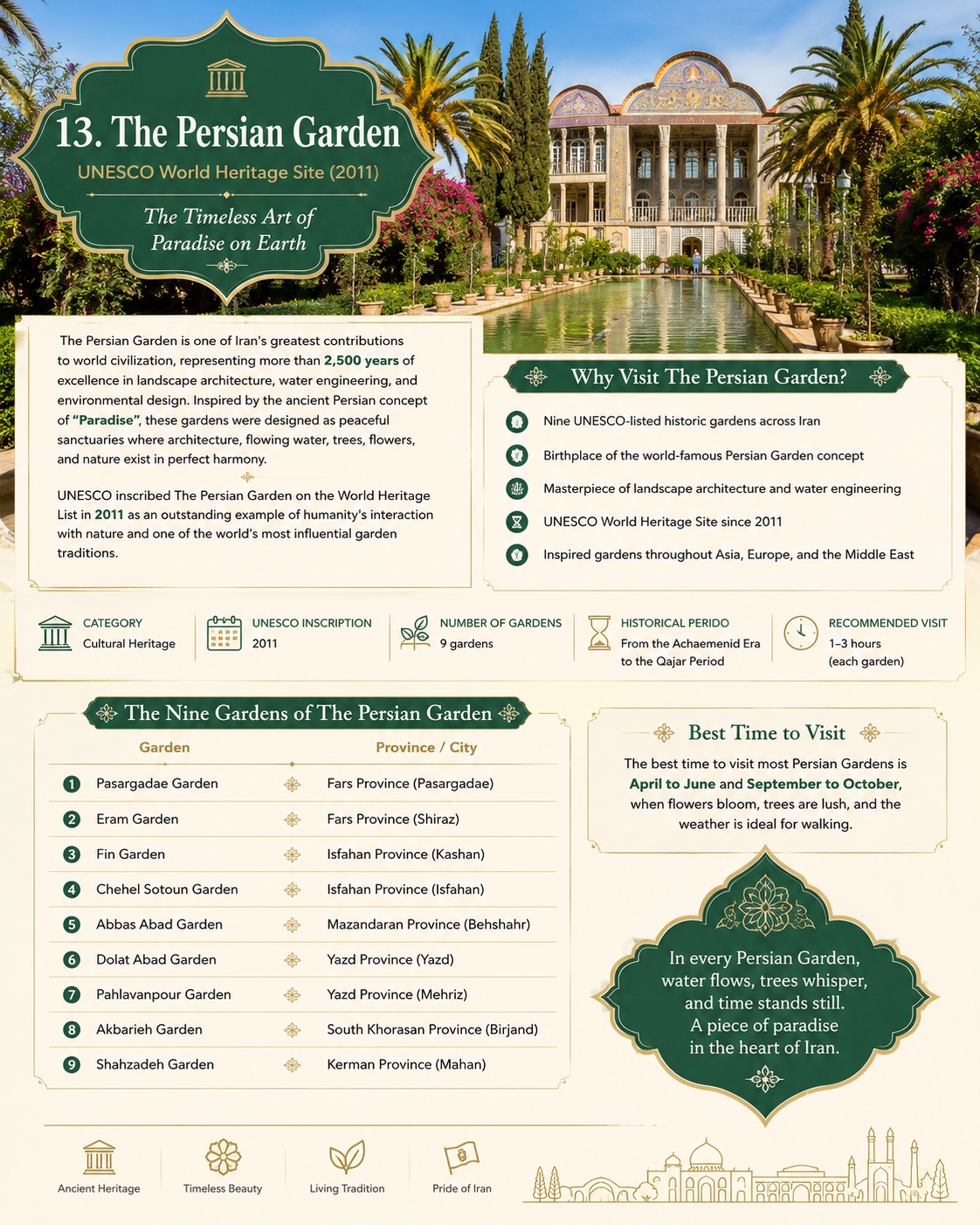
The Persian Garden is one of the most influential landscape traditions in the world and a remarkable expression of the relationship between humans, nature, and architecture. Inscribed on the UNESCO World Heritage List in 2011, the Persian Garden represents thousands of years of knowledge in landscape design, water management, and environmental adaptation. Developed over more than two millennia, Persian gardens were created as carefully planned spaces where water, plants, architecture, and geometry came together to create a sense of balance and harmony. In a country with vast deserts and dry regions, the garden became a symbol of life, beauty, and paradise on earth.
The word “Paradise” itself has roots in the ancient Persian word “Pairidaeza”, meaning an enclosed garden. This concept later influenced garden design traditions across the world, from Islamic gardens in the Middle East to European royal gardens.
The Philosophy Behind the Persian Garden
Unlike natural landscapes that grow without planning, Persian gardens were designed according to precise principles. Their layout usually followed the traditional Chahar Bagh (Four Gardens) concept, where the garden was divided into four sections by intersecting water channels and pathways.
Water played the central role in Persian garden design. Flowing streams, pools, fountains, and channels were not only decorative elements but also represented life, purity, and renewal.
The combination of:
Water
Trees and plants
Shade
Architecture
Symmetry
created a peaceful environment designed for reflection, relaxation, and connection with nature.
Ancient Roots and Cultural Influence
The origins of Persian garden design can be traced back to the Achaemenid period, especially the royal gardens of Pasargadae, where planned landscapes were integrated with palace architecture.
Over centuries, this tradition continued and evolved through different historical periods, including the Sassanid, Islamic, Safavid, and Qajar eras.
Persian gardens became important places for:
Royal ceremonies
Poetry and literature
Social gatherings
Artistic inspiration
Scientific and botanical studies
Their influence extended far beyond Iran, shaping garden traditions in regions connected through Persian culture and trade routes.
The Nine UNESCO Persian Gardens
The UNESCO inscription includes nine historic gardens representing different regions and styles of Persian garden design:
1. Pasargadae Garden – Fars Province
One of the earliest examples of Persian garden planning from the Achaemenid period.
2. Fin Garden – Kashan
Famous for its beautiful water features, historical buildings, and connection to Persian royal traditions.
3. Chehel Sotoun Garden – Isfahan
A Safavid masterpiece known for its palace, paintings, and reflection pool.
4. Eram Garden – Shiraz
A beautiful example of Qajar-era garden architecture and botanical diversity.
5. Shazdeh Garden – Kerman
A stunning desert garden created through advanced water management techniques.
6. Dolat Abad Garden – Yazd
Home to one of the tallest traditional windcatchers in Iran.
7. Abbasabad Garden – Mazandaran
A unique garden located in the northern forests of Iran.
8. Pahlavanpur Garden – Yazd Province
Known for its traditional water channels and historic buildings.
9. Akbarieh Garden – Birjand
A historic garden representing eastern Persian landscape traditions.
A Living Example of Human Adaptation
The Persian Garden demonstrates how ancient societies adapted to challenging environments through creativity and knowledge.
Many Persian gardens were created in regions where water was scarce. Through systems such as qanats, Persian engineers were able to bring water from underground sources and transform dry landscapes into beautiful green spaces.
This connection between engineering and beauty is one of the reasons Persian gardens remain unique in world heritage.
Why Visit Persian Gardens?
✔ UNESCO World Heritage Site since 2011
✔ One of the world’s most influential garden traditions
✔ A perfect combination of architecture, nature, and engineering
✔ Inspired garden design beyond Iran’s borders
✔ Includes some of Iran’s most beautiful historic landscapes
✔ Shows the Persian philosophy of harmony between humans and nature
Best Time to Visit
The best time to visit Persian gardens is during spring (March to May) when flowers are blooming and gardens are at their most beautiful.
Autumn is also an excellent season, especially for gardens in Kashan, Shiraz, and Isfahan, with pleasant weather and colorful landscapes.
Quick Information
📍 Location: Various regions of Iran (Fars, Isfahan, Yazd, Kerman, Kashan, Mazandaran, Birjand)
🏛 Category: Cultural Landscape
📅 UNESCO Inscription: 2011
🌿 Main Concept: Harmony between water, architecture, and nature
⏳ Historical Period: From Achaemenid era to Qajar period
🏗 Key Elements: Chahar Bagh design, water channels, pavilions, gardens
⏱ Recommended Visit: 1–3 Hours
🚗 Nearby Attractions: Persepolis, Shiraz gardens, Isfahan historic center, Yazd old city
19. The Persian Qanat
UNESCO World Heritage Site (2016)
The Persian Qanat – An Ancient Water Management System That Transformed Life in Arid Lands
Across the dry landscapes of Iran, where water has always been one of the most valuable resources, ancient Persian engineers developed one of the most remarkable water management systems in human history: the Qanat.
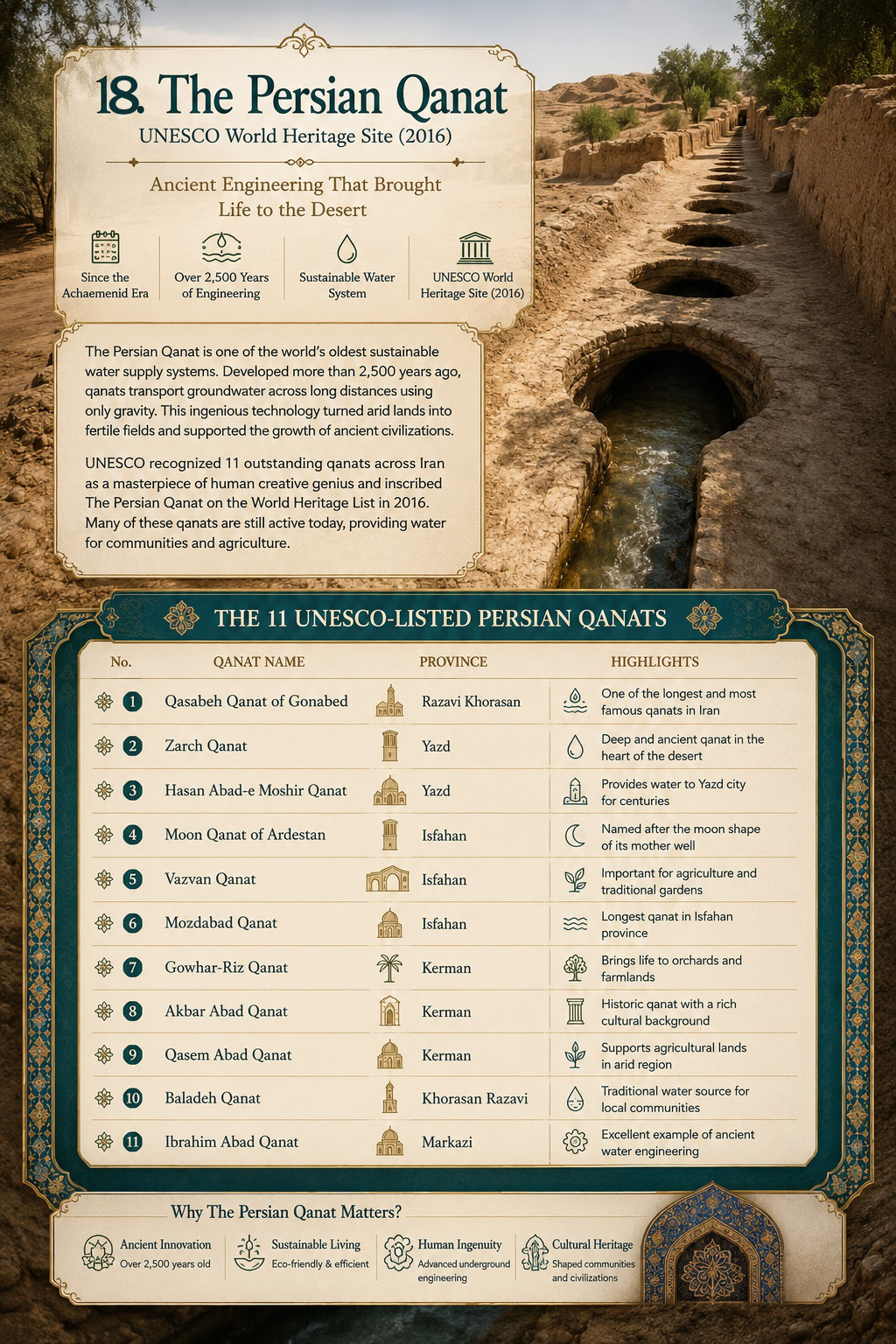
Inscribed on the UNESCO World Heritage List in 2016, the Persian Qanat represents an extraordinary achievement of engineering, environmental adaptation, and sustainable water management that has supported human life in Iran for more than 3,000 years.
A qanat is an underground water channel system designed to transfer groundwater from mountain aquifers to settlements and agricultural lands through a series of gently sloping tunnels. Instead of bringing water to the surface through pumps or modern technology, qanats used natural gravity, allowing water to travel long distances while reducing evaporation in Iran’s hot and dry climate.
The Persian Qanat system consists of several essential elements, including a deep vertical mother well, underground tunnels, ventilation shafts, and distribution channels. Skilled qanat builders, known as muqannis, carefully calculated underground slopes and water flow to create systems that could last for centuries.
Engineering Wisdom in Harmony with Nature
The importance of the Persian Qanat goes beyond its technical design. It represents a deep understanding of the relationship between humans and the environment.
By transporting groundwater underground, qanats helped communities overcome the challenges of living in arid regions. They provided reliable water for:
Agriculture and farming
Gardens and orchards
Villages and cities
Traditional Persian landscapes
This innovative approach allowed civilizations to flourish in areas where surface water was limited and contributed to the development of many historic settlements across Iran.
The Foundation of Persian Gardens and Settlements
The availability of controlled water resources played a major role in shaping Persian culture and architecture.
The qanat system was closely connected to the development of the Persian Garden, where water became the central element of landscape design. The movement of water through channels, pools, and fountains created gardens that represented beauty, balance, and harmony between nature and human creativity.
Many historic cities of Iran, including Yazd, Kerman, and Kashan, depended on qanats for centuries. These underground waterways made it possible to create green spaces, support agriculture, and sustain urban life in some of the driest regions of the country.
A Symbol of Sustainable Innovation
The Persian Qanat is considered one of the world’s earliest examples of sustainable water management. Without modern machinery or energy consumption, ancient engineers developed a system that worked with natural geography and preserved water resources.
The knowledge behind qanat construction spread beyond Iran and influenced water management traditions in other regions, including Central Asia, North Africa, and parts of the Mediterranean world.
Today, many qanats continue to function, demonstrating the durability and intelligence of this ancient technology.
A Living Heritage of Persian Civilization
The Persian Qanat is more than an engineering structure; it is a symbol of human creativity, adaptation, and respect for nature.
Visiting qanat sites offers travelers a different perspective on Iranian history — a history not only built by kings and monuments, but also by ordinary people whose knowledge and innovation allowed communities to survive and thrive for thousands of years.
The Persian Qanat reminds us that some of humanity’s greatest achievements are not always visible above ground; sometimes they flow silently beneath our feet.

Why Visit The Persian Qanat?
✔ UNESCO World Heritage Site since 2016
✔ One of the world’s oldest underground water systems
✔ A masterpiece of ancient Persian engineering
✔ Demonstrates sustainable use of natural resources
✔ Connected to the development of Persian gardens and settlements
✔ A unique example of living heritage still functioning today
Best Time to Visit
The best time to visit Persian Qanat sites is during spring (March to May) and autumn (September to November) when temperatures are comfortable for exploring historic cities and underground structures.
The qanats of Yazd, Kerman, and Kashan are among the most accessible for international visitors.
Quick Information
📍 Location: Various regions of Iran (including Yazd, Kerman, Khorasan, Isfahan, and Fars)
🏛 Category: Cultural Heritage / Engineering Heritage
📅 UNESCO Inscription: 2016
⏳ Historical Period: More than 3,000 years of development
💧 Main Feature: Underground water channels and traditional irrigation system
⚙️ Engineering Method: Gravity-based water transportation
⏱ Recommended Visit: 1–2 Hours
🚗 Nearby Attractions: Yazd Historic City, Persian Gardens, Desert Villages, Historic Water Systems
20. Cultural Landscape of Meymand
UNESCO World Heritage Site (2015)
Cultural Landscape of Meymand – A Living Cave Village with Thousands of Years of History
Nestled in the rugged mountains of Kerman Province, the Cultural Landscape of Meymand is one of the world's oldest continuously inhabited settlements and an extraordinary example of human adaptation to harsh natural environments. Inscribed on the UNESCO World Heritage List in 2015, Meymand preserves a unique way of life that has survived for thousands of years.
Unlike ordinary villages, Meymand is famous for its rock-cut dwellings, locally known as "Kicheh", which were carved directly into soft volcanic rock. More than 400 interconnected cave-like homes, along with animal shelters, storage rooms, and communal spaces, create a remarkable landscape where architecture and nature exist as one.
Archaeological evidence suggests that human activity in the Meymand region dates back several thousand years, while the present settlement has been inhabited continuously for centuries. The village reflects a rare example of a semi-nomadic lifestyle, where local families traditionally migrated seasonally between mountain pastures, agricultural lands, and their permanent rock houses.
The Cultural Landscape of Meymand represents much more than unusual architecture. It illustrates the close relationship between humans and nature, demonstrating how generations adapted to limited natural resources through sustainable living, traditional agriculture, animal husbandry, and efficient use of the surrounding environment.
Life in Meymand has changed very little over the centuries. Visitors can still experience traditional lifestyles, observe local customs, and meet residents who continue to preserve their unique cultural heritage. The village's stone houses naturally provide insulation against both the hot summers and cold winters of central Iran, showcasing remarkable environmental wisdom.
Recognizing its outstanding testimony to a traditional human settlement and its exceptional interaction between people and nature, UNESCO inscribed Meymand on the World Heritage List in 2015.
Today, Meymand offers travelers an unforgettable opportunity to step back in time and discover one of the world's most authentic living cultural landscapes.
Why Visit Meymand?
✔ UNESCO World Heritage Site since 2015
✔ One of the world's oldest continuously inhabited cave villages
✔ Unique rock-cut houses carved into the mountains
✔ Experience authentic rural life and local traditions
✔ A remarkable example of sustainable living and human adaptation
✔ Stunning mountain scenery and peaceful atmosphere
Best Time to Visit
The best time to visit Meymand is during spring (April to June) and autumn (September to October) when temperatures are pleasant for walking through the village and surrounding mountains.
Winter also offers a unique experience, as the rock dwellings provide natural warmth against the cold mountain climate.
Quick Information
📍 Location: Shahr-e Babak County, Kerman Province
🏛 Category: Cultural Heritage
📅 UNESCO Inscription: 2015
🏘 Main Feature: Ancient rock-cut cave village
⏳ Historical Period: Several thousand years of human occupation
👣 Cultural Significance: Traditional semi-nomadic lifestyle and sustainable settlement
⏱ Recommended Visit: 2–4 Hours or Overnight Stay
🚗 Nearby Attractions: Shahr-e Babak, Rayen Citadel, Kerman Historic City

21. The Cultural Landscape of Hawraman / Uramanat
UNESCO World Heritage Site (2021)
Hawraman (Uramanat) – A Living Mountain Landscape of Ancient Traditions
Nestled within the rugged Zagros Mountains of western Iran, the Cultural Landscape of Hawraman (Uramanat) stretches across Kurdistan and Kermanshah Provinces. This remarkable mountain region is renowned for its dramatic terraced villages, centuries-old stone architecture, rich cultural traditions, and the unique way its communities have adapted to the challenging mountainous environment for more than a thousand years.The villages of Hawraman are built into steep hillsides using locally quarried stone, creating a distinctive architectural style in which the roof of one house often serves as the courtyard of the house above it. This exceptional settlement pattern reflects a deep understanding of the landscape and a sustainable relationship between people and nature.
Beyond its architecture, Hawraman is celebrated for its living Kurdish culture, including traditional music, clothing, language, ceremonies, and agricultural practices that have been passed down through generations. Seasonal festivals, especially the Pir Shalyar Ceremony, continue to preserve the region's spiritual and cultural identity.
UNESCO inscribed the Cultural Landscape of Hawraman/Uramanat on the World Heritage List in 2021, recognizing it as an outstanding example of a living cultural landscape where human traditions and the natural environment have evolved together over centuries.Today, Hawraman offers visitors breathtaking mountain scenery, authentic Kurdish hospitality, traditional villages, and unforgettable cultural experiences unlike anywhere else in Iran.
Why Visit Hawraman?
✔ UNESCO World Heritage Site since 2021
✔ Spectacular terraced mountain villages
✔ Authentic Kurdish culture and traditions
✔ Magnificent Zagros Mountain landscapes
✔ Traditional stone architecture still in daily use
Best Time to Visit
The best time to visit Hawraman is April to June and September to October, when the mountains are green, the weather is pleasant, and local festivals take place.
Quick Information
📍 Location: Kurdistan & Kermanshah Provinces
🏛 Category: Cultural Heritage
📅 UNESCO Inscription: 2021
⏳ Historical Period: Ancient settlement traditions continuing to the present
⏱ Recommended Visit: 1–2 days
🚗 Highlights: Hawraman Takht, Uraman Villages, Pir Shalyar Festival

22. Trans-Iranian Railway
UNESCO World Heritage Site (2021)
Trans-Iranian Railway – An Engineering Masterpiece Connecting the Caspian Sea to the Persian Gulf.
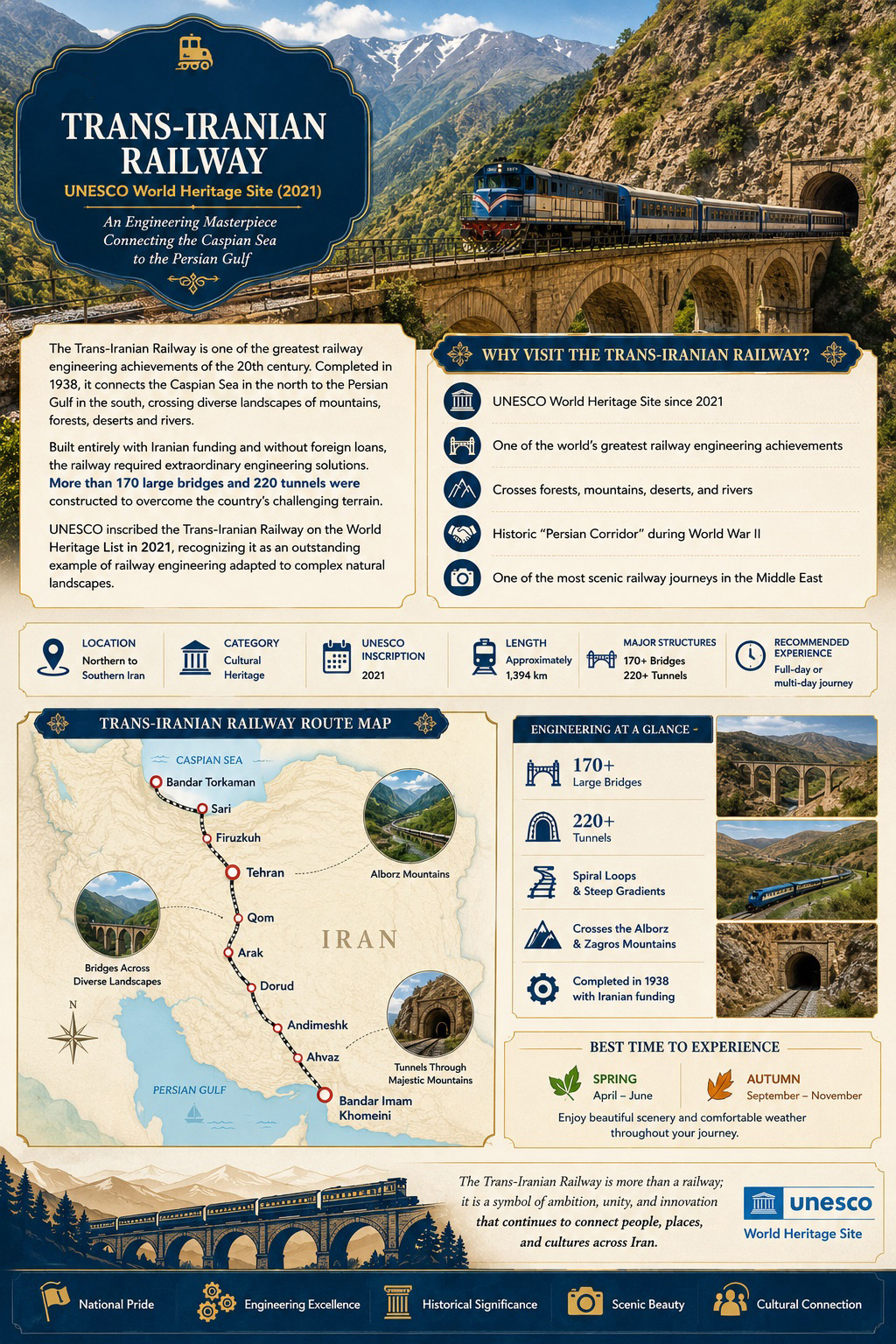
Stretching approximately 1,394 kilometers (866 miles) across Iran, the Trans-Iranian Railway is one of the greatest railway engineering achievements of the twentieth century. Completed in 1938, the railway connects the Caspian Sea in northern Iran with the Persian Gulf in the south, crossing some of the country's most challenging landscapes, including high mountain ranges, deep valleys, forests, deserts, and rivers.
Constructed entirely with Iranian government funding and without foreign loans, the railway required extraordinary engineering solutions. More than 170 large bridges, 220 tunnels, spiral loops, steep gradients, and complex mountain crossings were built to overcome the country's diverse geography. The line passes through the Alborz and Zagros Mountains, demonstrating the remarkable technical expertise involved in one of the most ambitious infrastructure projects of its time.Beyond its engineering significance, the Trans-Iranian Railway transformed Iran's economic, social, and cultural development by connecting remote regions and facilitating trade, travel, and national integration. It also played an important role during the Second World War, serving as the famous "Persian Corridor", which supplied Allied forces with vital resources.UNESCO inscribed the Trans-Iranian Railway on the World Heritage List in 2021, recognizing it as an outstanding example of railway engineering adapted to complex natural landscapes. Today, the railway remains one of the world's most scenic train journeys, offering breathtaking views of forests, mountains, deserts, bridges, and historic stations.
Why Visit the Trans-Iranian Railway?
✔ UNESCO World Heritage Site since 2021
✔ One of the world's greatest railway engineering achievements
✔ Crosses forests, mountains, deserts, and rivers
✔ Historic "Persian Corridor" during World War II
✔ One of the most scenic railway journeys in the Middle East
Best Time to Experience the Railway
The railway can be enjoyed throughout the year, but spring (April–June) and autumn (September–November) offer the most beautiful scenery and comfortable weather.
Quick Information
📍 Location: Northern to Southern Iran
🏛 Category: Cultural Heritage
📅 UNESCO Inscription: 2021
🚆 Length: Approximately 1,394 km
🌉 Major Structures: 170+ Bridges & 220+ Tunnels
⏱ Recommended Experience: Full-day or multi-day train journey
Chapter 04
Trade Routes and Living Heritage
In Roads That Connected Iran t0 the World
23. Tabriz Historic Bazaar Complex
UNESCO World Heritage Site (2010)
Tabriz Historic Bazaar Complex – The Largest Covered Bazaar in the World
Located in the heart of Tabriz, the Tabriz Historic Bazaar Complex is one of the oldest and largest covered bazaars in the world. For centuries, it served as one of the most important commercial centers along the Silk Roads, connecting merchants from Europe, Central Asia, the Middle East, India, and China. Its strategic location transformed Tabriz into a thriving center of trade, culture, and diplomacy.
The bazaar is not a single building but a vast urban complex consisting of interconnected brick corridors, domed halls, caravanserais, mosques, schools, bathhouses, workshops, and traditional shops. Each section was historically dedicated to a particular craft or trade, creating a highly organized commercial network that has remained active for centuries.
More than a marketplace, the Tabriz Bazaar has long been a social, cultural, and religious center where important economic and political events took place. UNESCO inscribed the Tabriz Historic Bazaar Complex on the World Heritage List in 2010, recognizing it as one of the world's most complete and best-preserved traditional trading centers.
Today, visitors can experience authentic Persian commerce, admire beautiful brick architecture, purchase traditional handicrafts and carpets, and enjoy the vibrant atmosphere that has characterized the bazaar for hundreds of years.
Why Visit Tabriz Historic Bazaar?
✔ The world's largest covered traditional bazaar
✔ One of the most important Silk Road trading centers
✔ UNESCO World Heritage Site since 2010
✔ Outstanding Persian brick architecture
✔ Famous for handmade carpets, spices, jewelry, and traditional crafts
Best Time to Visit
The best time to visit Tabriz is May to October, when the weather is pleasant for exploring the city's historic streets and bazaar.
Quick Information
📍 Location: East Azerbaijan Province
🏛 Category: Cultural Heritage
📅 UNESCO Inscription: 2010
⏳ Historical Period: Mainly Safavid and Qajar periods
⏱ Recommended Visit: 2–4 hours
🚶 Location: Historic center of Tabriz

24. The Persian Caravanserai
UNESCO World Heritage Site (2023)
The Persian Caravanserai – Ancient Inns Along the Silk Roads
For more than two thousand years, Persian caravanserais served as essential resting places for merchants, pilgrims, diplomats, and travelers crossing the vast landscapes of Iran. Strategically located along the Silk Roads and other historic trade routes, these fortified roadside inns provided accommodation, food, water, security, and stables for caravans traveling between East and West.
UNESCO's World Heritage inscription includes 54 carefully selected caravanserais across 24 provinces of Iran, representing different architectural styles, climates, and historical periods from the Sasanian Era through the Safavid and Qajar dynasties. Built in deserts, mountains, forests, and plains, each caravanserai reflects innovative solutions adapted to its local environment while maintaining the fundamental principles of Persian hospitality and travel.
Beyond their architectural beauty, Persian caravanserais played a crucial role in facilitating international trade, cultural exchange, diplomacy, and the movement of knowledge across Asia, Europe, and the Middle East. They became vibrant centers where merchants exchanged goods, ideas, languages, and traditions, contributing significantly to the prosperity of the Silk Roads.
Recognizing their outstanding universal value, UNESCO inscribed The Persian Caravanserai on the World Heritage List in 2023. Together, these historic inns tell the story of Iran's central role in connecting civilizations for centuries.
Today, many caravanserais have been beautifully restored and transformed into museums, cultural centers, boutique hotels, restaurants, and visitor attractions, offering travelers a unique opportunity to experience the atmosphere of ancient Persian journeys.
Why Visit Persian Caravanserais?
✔ UNESCO World Heritage Site since 2023
✔ Includes 54 historic caravanserais across Iran
✔ Important landmarks of the Silk Roads
✔ Outstanding examples of Persian architecture
✔ Many are now boutique hotels and cultural attractions
Best Time to Visit
Persian caravanserais can be visited throughout the year, although spring and autumn provide the most comfortable weather for exploring different regions of Iran.
Quick Information
📍 Location: 24 Provinces Across Iran
🏛 Category: Cultural Heritage
📅 UNESCO Inscription: 2023
🏠 Number of Caravanserais: 54
⏳ Historical Period: Sasanian to Qajar
⏱ Recommended Visit: 1–2 hours (each site)
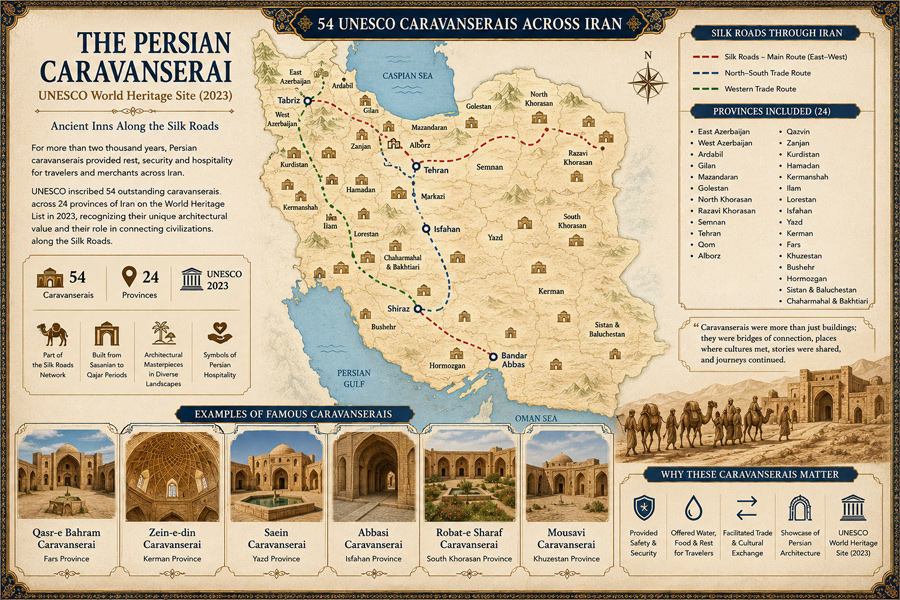
25. Bam and its Cultural Landscape
UNESCO World Heritage Site (2004)
Bam and its Cultural Landscape – The World's Largest Adobe City
Located in Kerman Province, Bam and its Cultural Landscape is home to Arg-e Bam, the largest adobe (mud-brick) fortress in the world. With a history spanning more than 2,000 years, Bam flourished as a major trading center along the ancient Silk Roads, connecting Persia with Central Asia, India, and the Middle East.
The magnificent citadel, together with its surrounding oasis, historic gardens, irrigation system (qanats), residential quarters, and defensive walls, demonstrates the remarkable adaptation of human settlements to the harsh desert environment. For centuries, Bam was renowned for its strategic location, agricultural prosperity, and production of silk, cotton, and dates.
In December 2003, a devastating earthquake severely damaged Arg-e Bam and much of the historic city. Thanks to extensive international cooperation and conservation efforts, the site has undergone one of the world's most significant heritage restoration projects. UNESCO inscribed Bam and its Cultural Landscape on the World Heritage List in 2004, recognizing both its outstanding universal value and the importance of preserving this extraordinary example of desert urban planning.
Today, Bam stands as a powerful symbol of resilience, cultural continuity, and architectural ingenuity, attracting visitors from around the world.
Why Visit Bam?
✔ Home to the world's largest adobe fortress
✔ Exceptional example of desert architecture
✔ Historic Silk Road trading center
✔ UNESCO World Heritage Site since 2004
✔ Symbol of successful international heritage restoration
Best Time to Visit
The best time to visit Bam is October to April, when the desert climate is cooler and ideal for sightseeing.
Quick Information
📍 Location: Kerman Province
🏛 Category: Cultural Heritage
📅 UNESCO Inscription: 2004
⏳ Historical Period: From the Achaemenid period to the Qajar era
⏱ Recommended Visit: 2–3 hours
🚗 Nearest City: Bam
Chapter 05
Origins of Human Civilization and Mountain Fortresses
From Early Humans to Medieval Strongholds
26. Shahr-i Sokhta (The Burnt City)
UNESCO World Heritage Site (2014)
Shahr-i Sokhta – The Burnt City, Cradle of One of the World's Earliest Civilizations
Located in Sistan and Baluchestan Province in southeastern Iran, Shahr-i Sokhta (The Burnt City) is one of the most important archaeological sites of the Bronze Age and one of the earliest examples of urban civilization on the Iranian Plateau. Inscribed on the UNESCO World Heritage List in 2014, the site offers an exceptional window into the emergence of complex societies more than 5,000 years ago.
Founded around 3200 BC, Shahr-i Sokhta flourished for nearly 1,400 years as a major center of trade, craftsmanship, and innovation at the crossroads of ancient trade routes linking Mesopotamia, Central Asia, the Indus Valley, and the Iranian Plateau. Its strategic location allowed it to become one of the most influential cities of the ancient East.
Archaeological excavations have revealed a highly organized city with residential neighborhoods, industrial workshops, monumental buildings, cemeteries, and sophisticated water management systems. Thousands of artifacts—including pottery, jewelry, seals, textiles, and tools—demonstrate the advanced craftsmanship and social organization of its inhabitants.
Among the site's most remarkable discoveries are the world's earliest known artificial eyeball, discovered in the burial of a high-status woman, one of the oldest examples of brain surgery (trepanation) with evidence of patient survival, and a decorated pottery vessel that depicts a jumping goat in sequential images—often described as one of the earliest examples of animation in human history.
The decline of Shahr-i Sokhta is believed to have resulted from environmental changes, including shifts in river courses and increasing aridity, leading to its abandonment around 1800 BC. Despite this, the dry desert climate has preserved the city's remains remarkably well.
Today, Shahr-i Sokhta stands as one of the world's most significant archaeological sites, revealing the ingenuity, creativity, and achievements of one of humanity's earliest urban civilizations.
Why Visit Shahr-i Sokhta?
✔ UNESCO World Heritage Site since 2014
✔ One of the world's oldest Bronze Age cities
✔ More than 5,000 years of history
✔ Home to groundbreaking archaeological discoveries
✔ A key center of ancient trade and civilization
✔ One of Iran's most important archaeological destinations
Best Time to Visit
The best time to visit Shahr-i Sokhta is from October to April, when temperatures in southeastern Iran are pleasant for exploring the archaeological site.
Quick Information
📍 Location: Sistan and Baluchestan Province
🏛 Category: Cultural Heritage
📅 UNESCO Inscription: 2014
⏳ Historical Period: Bronze Age (c. 3200–1800 BC)
🏺 Main Features: Ancient city, cemetery, workshops, archaeological museum
⏱ Recommended Visit: 2–3 Hours
🚗 Nearby Attractions: Zabol, Hamun Lake, Mount Khajeh

27. Prehistoric Sites of the Khorramabad Valley
UNESCO World Heritage Site (2025)
Prehistoric Sites of the Khorramabad Valley – Tracing the Earliest Chapters of Human History
Nestled within the Zagros Mountains in Lorestan Province, the Prehistoric Sites of the Khorramabad Valley preserve one of the world's most significant records of early human occupation. Inscribed on the UNESCO World Heritage List in 2025, the serial property includes five prehistoric caves and one rock shelter that document nearly 63,000 years of human presence, from the Middle Paleolithic onward.
The valley occupies a strategic position along one of the major routes used by early modern humans as they dispersed from Africa into Eurasia. Its caves, abundant water sources, rich wildlife, and favorable climate created ideal conditions for human settlement over tens of thousands of years.
The UNESCO property includes the caves of Kaldar, Ghamari, Gilvaran, Yafteh, Kunji, and the Gar Arjeneh Rock Shelter. Excavations have uncovered stone tools, animal remains, hearths, and evidence of changing human behavior across different prehistoric periods, providing invaluable information about survival, technology, and adaptation.
These discoveries have transformed the Khorramabad Valley into one of the most important prehistoric research centers in Southwest Asia. They offer exceptional insight into the evolution of human societies and their adaptation to changing environments over thousands of generations.
Today, the valley is not only a destination for archaeologists and researchers but also for travelers seeking to explore one of the earliest chapters of human history while enjoying the spectacular landscapes of the Zagros Mountains.
Why Visit the Khorramabad Valley?
✔ UNESCO World Heritage Site since 2025
✔ Evidence of nearly 63,000 years of human occupation
✔ One of the world's most important prehistoric cave complexes
✔ Key site for understanding early human migration and evolution
✔ Beautiful mountain landscapes and rich archaeological heritage
✔ A unique destination for history and nature lovers
Best Time to Visit
The best time to visit the Khorramabad Valley is during spring (April to June) and autumn (September to October), when the weather is mild and ideal for exploring the caves and surrounding natural landscapes.
Quick Information
📍 Location: Khorramabad, Lorestan Province
🏛 Category: Cultural Heritage
📅 UNESCO Inscription: 2025
⏳ Historical Period: Middle Paleolithic to later prehistoric periods (up to 63,000 years ago)
🪨 Main Features: Kaldar Cave, Ghamari Cave, Gilvaran Cave, Yafteh Cave, Kunji Cave, Gar Arjeneh Rock Shelter
⏱ Recommended Visit: Half Day to Full Day
🚗 Nearby Attractions: Falak-ol-Aflak Castle, Khorramabad Lake, Bisheh Waterfall
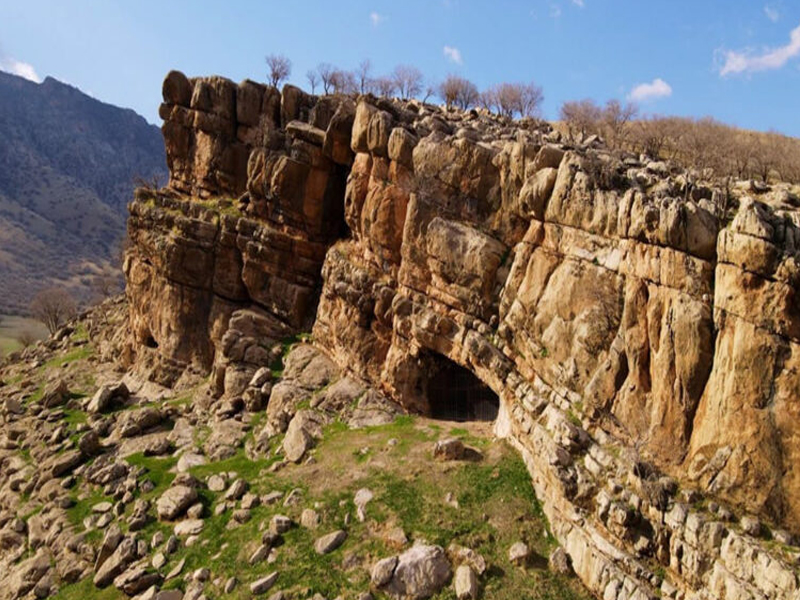
28. Alamūt Castle and Related Fortifications
UNESCO World Heritage Site (2026)
Alamūt Castle and Related Fortifications – The Legendary Mountain Fortress of Medieval Persia
Nestled among the dramatic peaks of the Alborz Mountains in Qazvin Province, Alamūt Castle and Related Fortifications represent one of the most remarkable defensive landscapes of the medieval Islamic world. Inscribed on the UNESCO World Heritage List in 2026, the serial property includes Alamūt Castle and six associated mountain fortresses, illustrating the political, military, and intellectual center of the Nizari Ismaili State from the late 11th to the mid-13th century.
Built on steep mountain ridges with limited access, these fortifications demonstrate extraordinary engineering adapted to rugged terrain. Beyond their military role, they served as centers of learning, scholarship, administration, and water management, reflecting a sophisticated society capable of thriving in one of Iran's most challenging landscapes.
Although much of Alamūt was destroyed during the Mongol invasion in 1256, archaeological remains continue to reveal advanced defensive systems, reservoirs, residential quarters, and evidence of a flourishing intellectual tradition.
Today, Alamūt offers visitors spectacular mountain scenery, fascinating medieval history, and one of Iran's most iconic archaeological landscapes.
Why Visit Alamūt?
✔ UNESCO World Heritage Site since 2026
✔ Legendary mountain fortress of Hassan-i Sabbah
✔ Outstanding medieval military architecture
✔ Breathtaking Alborz Mountain scenery
✔ One of Iran's newest UNESCO World Heritage Sites
Best Time to Visit
May to October offers the best weather for hiking and exploring the mountain landscape.
Quick Information
📍 Location: Qazvin Province
🏛 Category: Cultural Heritage
📅 UNESCO Inscription: 2026
⏳ Historical Period: 11th–13th Century CE
🏰 Main Features: Alamūt Castle, Lambesar, six associated fortifications
⏱ Recommended Visit: Half Day
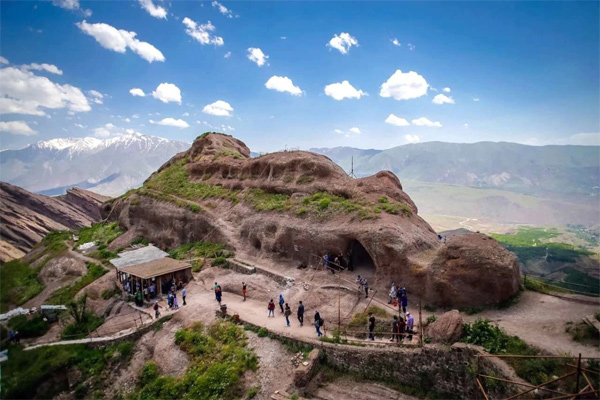
Chapter 06
Natural Heritage
Iran's Unique Natural Wonders
29. Lut Desert
UNESCO World Heritage Site (2016)
Lut Desert – One of the Hottest and Most Extraordinary Deserts on Earth
Stretching across southeastern Iran, the Lut Desert (Dasht-e Lut) is one of the world's most spectacular natural landscapes. Inscribed on the UNESCO World Heritage List in 2016, it was Iran's first natural World Heritage Site and is internationally recognized for its exceptional geological formations and extreme desert environment.
Over millions of years, wind erosion has sculpted enormous yardangs, towering ridges of sedimentary rock that create one of the planet's most dramatic desert landscapes. The Lut Desert also features vast sand dunes, salt plains, gravel deserts, and volcanic formations, illustrating ongoing geological processes.
Satellite observations have recorded some of the highest land surface temperatures ever measured on Earth within the Lut Desert, making it one of the hottest places on the planet.
Despite its harsh environment, the Lut Desert possesses remarkable natural beauty, especially at sunrise and sunset when its sculpted formations glow with shades of gold and red.
Why Visit Lut Desert?
✔ UNESCO World Heritage Site since 2016
✔ Iran's first natural World Heritage Site
✔ Home to spectacular yardang formations
✔ One of Earth's hottest places
✔ Incredible destination for photography and adventure tourism
Best Time to Visit
The ideal time to visit is November to March, when temperatures are suitable for desert exploration.
Quick Information
📍 Location: Kerman, South Khorasan & Sistan and Baluchestan Provinces
🌿 Category: Natural Heritage
📅 UNESCO Inscription: 2016
🏜 Main Features: Yardangs, sand dunes, salt plains, desert landscapes
⏱ Recommended Visit: 1–2 Days

30. Hyrcanian Forests
UNESCO World Heritage Site (2019)
Hyrcanian Forests – Ancient Broadleaf Forests Older Than the Ice Age
Stretching along the southern coast of the Caspian Sea, the Hyrcanian Forests form one of the world's oldest temperate forests. Recognized by UNESCO in 2019 and later extended in 2023, these forests preserve living ecosystems dating back 25 to 50 million years, earning them the nickname "Living Fossil Forests."
Covering parts of Gilan, Mazandaran, Golestan, North Khorasan, and Semnan Provinces, the Hyrcanian Forests escaped the Ice Ages that transformed much of Europe. As a result, many ancient plant species survived here and continue to thrive today.
The forests are home to exceptional biodiversity, including the Persian leopard, brown bear, gray wolf, wild boar, numerous bird species, and hundreds of endemic plants. Dense forests, mist-covered mountains, rivers, waterfalls, and rich wildlife make this region one of the most beautiful natural destinations in the Middle East.
The Hyrcanian Forests are not only a biodiversity hotspot but also play a crucial role in climate regulation, soil conservation, and water resources for northern Iran.
Why Visit the Hyrcanian Forests?
✔ UNESCO World Heritage Site since 2019
✔ Ancient forests dating back 25–50 million years
✔ Home to the Persian leopard and unique wildlife
✔ Spectacular hiking and ecotourism opportunities
✔ One of the world's oldest temperate forest ecosystems
Best Time to Visit
The forests are beautiful throughout the year, but spring (April–June) and autumn (September–November) provide the most pleasant weather and vibrant scenery.
Quick Information
📍 Location: Gilan, Mazandaran, Golestan, North Khorasan & Semnan Provinces
🌿 Category: Natural Heritage
📅 UNESCO Inscription: 2019 (extended in 2023)
🌳 Main Features: Ancient temperate forests, endemic flora, rich wildlife
🐆 Notable Wildlife: Persian Leopard, Brown Bear, Gray Wolf
⏱ Recommended Visit: 1–3 Days

UNESCO World Heritage Sites in Iran
The Complete Guide to Iran's 30 UNESCO World Heritage Sites
Few countries tell the story of human civilization as completely as Iran. Home to one of the world's oldest continuous civilizations, Iran preserves more than 8,000 years of history through its remarkable archaeological sites, ancient capitals, historic cities, engineering masterpieces, cultural landscapes, and breathtaking natural wonders. From the ceremonial splendor of Persepolis and the timeless beauty of Yazd to the lush Hyrcanian Forests and the newly inscribed Alamut Castle, every UNESCO World Heritage Site reveals a unique chapter in the story of Persia and its enduring influence on world civilization.
As of July 2026, Iran is home to 30 UNESCO World Heritage Sites, placing it among the countries with the richest cultural heritage in the Middle East. These include 28 cultural and 2 natural World Heritage Sites that span thousands of years of human achievement. The latest addition, Alamut Castle and Related Fortifications, was inscribed during the 48th Session of the UNESCO World Heritage Committee, becoming Iran's 30th World Heritage Site and highlighting another remarkable chapter of the country's medieval history.
This comprehensive guide brings together all 30 UNESCO World Heritage Sites in Iran in one place. Whether you are planning your first journey to Iran, researching Persian history, or searching for the country's most extraordinary travel destinations, you will discover detailed information about each UNESCO site, including its historical significance, location, architectural features, and cultural importance.
Rather than simply presenting a list of monuments, this guide invites you to journey through the evolution of one of humanity's greatest civilizations. From the sacred temples of ancient Elam and the imperial capitals of the Achaemenid kings to magnificent Islamic architecture, ingenious Persian engineering, timeless caravan routes, and extraordinary natural landscapes, Iran's UNESCO World Heritage Sites reflect thousands of years of creativity, innovation, and cultural exchange that continue to inspire visitors from around the world.
Why UNESCO World Heritage Matters?
UNESCO World Heritage Sites are places recognized for their Outstanding Universal Value (OUV)—a distinction reserved for cultural and natural treasures considered important not only to one nation but to all humanity. These sites represent exceptional achievements in architecture, archaeology, engineering, science, urban planning, cultural traditions, or natural history, and are protected under the UNESCO World Heritage Convention to ensure they are preserved for future generations.
World Heritage designation is more than an international honor. It encourages conservation, promotes sustainable tourism, supports scientific research, and raises global awareness about the importance of protecting irreplaceable cultural and natural heritage. In many cases, UNESCO recognition also strengthens local communities by creating new opportunities for education, employment, and responsible tourism.
For travelers, UNESCO World Heritage Sites offer far more than beautiful landmarks. They provide authentic experiences and a deeper understanding of the people, cultures, and civilizations that shaped our world. Visiting these extraordinary places means walking through thousands of years of history while helping to support the preservation of humanity's shared heritage.
Whether exploring the ancient palaces of Persepolis, wandering through the historic streets of Yazd, admiring the engineering genius of the Persian Qanats, or hiking among the ancient Hyrcanian Forests, every UNESCO World Heritage Site in Iran tells a story that connects the past with the present and preserves it for the future.
Quick Facts About Iran's UNESCO World Heritage Sites
Chapter One
Ancient Persia
The Birth of Iranian Civilization
1. Chogha Zanbil
UNESCO World Heritage Site (1979)
Chogha Zanbil – The Ancient Elamite Ziggurat of Iran
Located near the ancient city of Susa in Khuzestan Province, Chogha Zanbil is one of the most remarkable archaeological monuments of the ancient Near East and the first site in Iran to be inscribed on the UNESCO World Heritage List in 1979.
Built around 1250 BC by King Untash-Napirisha, ruler of the Elamite civilization, Chogha Zanbil was created as a sacred city dedicated to the Elamite gods, especially Inshushinak, the patron deity of Susa. The site represents one of the greatest achievements of ancient Iranian architecture and religious construction.
The most impressive feature of Chogha Zanbil is its massive ziggurat, a unique stepped temple structure that is among the best-preserved examples of its kind outside Mesopotamia. Unlike many ancient monuments that have been heavily damaged over time, Chogha Zanbil has preserved much of its original form, allowing visitors to understand the religious beliefs, architectural skills, and urban planning of the Elamites.
The ancient complex was surrounded by three enormous defensive walls and included temples, royal areas, ceremonial spaces, and residential quarters. The construction demonstrates advanced knowledge of engineering, brick production, water management, and urban design more than 3,000 years ago.
Thousands of inscribed bricks discovered at the site provide valuable information about Elamite language, religion, and political history. These inscriptions reveal the importance of Chogha Zanbil as a spiritual center and demonstrate the sophistication of one of Iran’s earliest civilizations.
Although the city was never fully completed and later declined after the fall of the Elamite Kingdom, Chogha Zanbil remains a powerful symbol of ancient Iranian heritage. Together with other sites such as Susa and Persepolis, it represents the long continuity of civilization on the Iranian plateau.
Today, visiting Chogha Zanbil offers travelers a rare opportunity to step back into the world of ancient Persia and explore one of humanity’s earliest monumental religious landscapes. Standing among its massive brick walls and ancient temples, visitors can experience the legacy of a civilization that flourished long before the rise of the Persian Empire.
Why Visit Chogha Zanbil?
✔ The first UNESCO World Heritage Site of Iran (1979)
✔ One of the best-preserved ancient ziggurats in the world
✔ A unique symbol of the Elamite civilization
✔ More than 3,000 years of history
✔ One of the oldest examples of monumental architecture in Iran
✔ Located near the ancient city of Susa and other historical attractions
Best Time to Visit
The best time to visit Chogha Zanbil is from October to April, when Khuzestan’s climate is cooler and more comfortable for outdoor exploration.
Spring (March–April) is especially pleasant, with mild temperatures and better conditions for visiting archaeological sites in southwestern Iran.
Quick Information
📍 Location: Khuzestan Province, near Susa
🏛 Category: Cultural Heritage
📅 UNESCO Inscription: 1979
👑 Built By: King Untash-Napirisha (Elamite Empire)
⏳ Historical Period: Elamite Civilization (around 1250 BC)
🏗 Main Feature: Ancient Ziggurat and Sacred City
⏱ Recommended Visit: 1.5–2 Hours
🚗 Nearby Attractions: Susa Ancient City, Haft Tappeh Archaeological Site, Shushtar Historical Hydraulic System
02. Susa (Shush)
UNESCO World Heritage Site (2015)
Susa – One of the World’s Oldest Continuously Inhabited Cities
Located in Khuzestan Province in southwestern Iran, Susa (Shush) is one of the oldest continuously inhabited cities in the world and one of the most important archaeological sites of the ancient Near East. Inscribed on the UNESCO World Heritage List in 2015, Susa represents more than 6,000 years of human settlement, cultural exchange, and political importance.
Situated between the Mesopotamian plains and the Iranian plateau, Susa developed as a major center of the Elamite civilization, one of the earliest civilizations of ancient Iran. For thousands of years, the city served as a political, religious, and cultural hub, connecting different civilizations across the region.
The earliest settlements at Susa date back to around 4000 BC, making it one of the oldest urban centers in human history. Archaeological discoveries have revealed impressive remains of ancient temples, palaces, administrative buildings, residential areas, and artistic objects that demonstrate the advanced urban culture of its inhabitants.
During the Elamite period, Susa became the capital and one of the most important religious centers of the kingdom. The city was closely associated with the worship of Elamite gods, especially Inshushinak, the protective deity of Susa. Many discoveries from this period provide valuable information about early writing systems, administration, and artistic traditions.
Following the rise of the Achaemenid Empire, Susa gained even greater importance and became one of the empire’s royal capitals alongside Persepolis, Pasargadae, and Babylon. Darius the Great built a magnificent palace complex at Susa, decorated with glazed brick artworks, stone carvings, and architectural elements created by craftsmen from different parts of the vast Persian Empire.
The Apadana Palace of Susa reflects the multicultural nature of the Achaemenid Empire. Similar to Persepolis, its artistic decorations show representatives from various nations bringing gifts to the Persian king, symbolizing unity among different peoples under Achaemenid rule.
Susa continued to play an important role during later historical periods, including the Seleucid, Parthian, Sasanian, and Islamic eras. This long continuity makes Susa a unique example of how cities can evolve and preserve layers of human history over thousands of years.
Today, visitors to Susa can explore the archaeological remains of ancient palaces, the Susa Museum, and nearby historical sites such as Chogha Zanbil and Haft Tappeh. Together, these attractions reveal the story of one of the oldest civilizations of Iran and its lasting contribution to world heritage.
Why Visit Susa?
✔ One of the oldest continuously inhabited cities in the world
✔ UNESCO World Heritage Site since 2015
✔ Capital of the ancient Elamite civilization
✔ Important royal city of the Achaemenid Empire
✔ Home to the palace of Darius the Great
✔ A unique destination combining Elamite, Persian, and Islamic history
Best Time to Visit
The best time to visit Susa is from October to April, when the weather in Khuzestan is cooler and more suitable for outdoor exploration.
Spring is also a beautiful season to visit, especially when the surrounding landscapes become greener.
Quick Information
📍 Location: Khuzestan Province, near Shush
🏛 Category: Cultural Heritage
📅 UNESCO Inscription: 2015
👑 Founded: Around 4000 BC
⏳ Historical Period: Elamite, Achaemenid, Seleucid, Parthian, Sasanian & Islamic Periods
🏗 Main Features: Ancient City, Apadana Palace, Royal Complexes
⏱ Recommended Visit: 2–3 Hours
🚗 Nearby Attractions: Chogha Zanbil, Haft Tappeh Archaeological Site, Shushtar Historical Hydraulic System2. Persepolis
03. Hegmataneh (Ecbatana)
UNESCO World Heritage Site (2024)
Hegmataneh (Ecbatana) – The Ancient Capital of the Median Empire
Located in the modern city of Hamadan, Hegmataneh (ancient Ecbatana) is one of the oldest urban settlements in Iran and one of the most important archaeological sites in the Middle East. According to historical sources, the city was founded in the 7th century BC by Deioces, the first king of the Median Empire, making it the earliest known capital of the Medes.
Throughout its long history, Hegmataneh remained a significant political and administrative center during the Median, Achaemenid, Seleucid, Parthian, and Sasanian periods. It later continued to flourish during the Islamic era, reflecting more than 2,700 years of continuous urban development.
Archaeological excavations have revealed a remarkably planned ancient city featuring regular streets, residential quarters, fortification walls, workshops, drainage systems, and numerous historical artifacts. The site also includes important monuments such as the Hegmataneh Museum, the Church of Gregory the Illuminator, and the nearby Tomb of Avicenna (Ibn Sina), making Hamadan one of Iran's richest cultural destinations.
Recognizing its exceptional testimony to early urban planning and its importance in the history of Iranian civilization, UNESCO inscribed Hegmataneh on the World Heritage List in 2024.
Today, Hegmataneh offers visitors an extraordinary opportunity to explore the origins of one of the world's earliest kingdoms while discovering thousands of years of Iranian history preserved beneath the modern city.
Why Visit Hegmataneh?
✔ Capital of the ancient Median Empire
✔ UNESCO World Heritage Site since 2024
✔ More than 2,700 years of history
✔ One of Iran's oldest archaeological cities
✔ Close to the Tomb of Avicenna and other historic attractions
Best Time to Visit
The best time to visit Hamadan is May to September, when the mountain climate is cool and ideal for exploring archaeological sites.
Quick Information
📍 Location: Hamadan Province
🏛 Category: Cultural Heritage
📅 UNESCO Inscription: 2024
👑 Founded: 7th Century BC
⏳ Historical Period: Median, Achaemenid, Parthian, Sasanian & Islamic
⏱ Recommended Visit: 2–3 Hours
🚗 Nearby Attractions: Tomb of Avicenna, Alavian Dome, Ganjnameh
04. Pasargadae
UNESCO World Heritage Site (2004)
Pasargadae – The First Capital of the Achaemenid Empire and the Tomb of Cyrus the Great
Located in the plains of Fars Province, near the city of Shiraz, Pasargadae was the first dynastic capital of the Achaemenid Empire and one of the most important archaeological sites of ancient Iran. Inscribed on the UNESCO World Heritage List in 2004, Pasargadae represents the beginning of one of the greatest empires in human history and preserves the legacy of its founder, Cyrus the Great.
The city was established around 550 BC by Cyrus the Great after his victory over the Median Empire and the foundation of the Achaemenid dynasty. Unlike many ancient capitals built mainly for defense, Pasargadae was designed as an open royal landscape that combined palaces, gardens, ceremonial spaces, and monumental architecture in harmony with nature.
The most famous monument of Pasargadae is the Tomb of Cyrus the Great, a simple yet powerful stone structure that has survived for more than 2,500 years. Built from large limestone blocks, the tomb reflects the architectural style of the early Achaemenid period and remains one of the most recognizable symbols of Persian history.
Beyond the tomb, the archaeological complex includes several important structures such as the Gate of Pasargadae, the Audience Hall, the Private Palace of Cyrus, and the remains of royal gardens. These elements demonstrate the early development of the Persian Garden concept, where water channels, vegetation, and architecture were carefully integrated to create a harmonious environment.
Pasargadae also reflects the unique vision of Cyrus the Great, whose rule was known for administrative innovation, respect for different cultures, and the creation of a vast multicultural empire. The ideas developed during this period influenced Persian governance and architecture for centuries.
The design of Pasargadae introduced many features that later became characteristic of Persian architecture, including monumental stone construction, planned gardens, and the combination of natural landscapes with royal spaces. Its influence can be seen in later Persian sites such as Persepolis and other historic gardens across Iran.
Today, Pasargadae offers visitors a chance to explore the origins of the Achaemenid Empire and experience one of the most important places connected to the history of ancient Persia. Standing beside the Tomb of Cyrus and walking through the remains of the royal complex provides a powerful connection to one of the earliest chapters of Persian civilization.
Why Visit Pasargadae?
✔ The first capital of the Achaemenid Empire
✔ UNESCO World Heritage Site since 2004
✔ Home to the Tomb of Cyrus the Great
✔ One of the earliest examples of Persian garden design
✔ A key site for understanding the origins of Persian civilization
✔ Located near Persepolis and Naqsh-e Rostam
Best Time to Visit
The best time to visit Pasargadae is during spring (March to May) and autumn (September to November) when the weather in Fars Province is mild and ideal for outdoor exploration.
Morning and late afternoon visits are recommended, especially for photography and avoiding midday heat.
Quick Information
📍 Location: Fars Province, near Shiraz
🏛 Category: Cultural Heritage
📅 UNESCO Inscription: 2004
👑 Founded By: Cyrus the Great
⏳ Historical Period: Achaemenid Empire (6th Century BC)
🏗 Main Features: Tomb of Cyrus the Great, Royal Palaces, Persian Gardens
⏱ Recommended Visit: 1–2 Hours
🚗 Nearby Attractions: Persepolis, Naqsh-e Rostam, Shiraz Historic Sites
05. Persepolis – The Ceremonial Capital of the Achaemenid Empire
Rising from the plains of Fars Province, Persepolis stands as one of the greatest archaeological treasures of the ancient world and the most iconic symbol of the Achaemenid Empire (550–330 BC). Founded by King Darius I around 518 BC and later expanded by Xerxes I and Artaxerxes I, Persepolis served as the magnificent ceremonial capital of the Persian Empire—the largest empire of its time, stretching across three continents.
Rather than functioning as an ordinary administrative city, Persepolis was designed as a grand ceremonial complex where representatives from across the empire gathered to celebrate Nowruz (Persian New Year) and present tribute to the King of Kings. The monumental terraces, palaces, gateways, audience halls, royal treasury, and exquisite stone reliefs reflect the political power, artistic excellence, and cultural diversity of ancient Persia.
Among the site's most famous monuments are the Gate of All Nations, the Apadana Palace, the Hall of One Hundred Columns, the Tripylon, the Royal Treasury, and the magnificent royal tombs carved into the nearby cliffs of Naqsh-e Rostam. The beautifully carved reliefs depicting delegates from more than twenty nations symbolize the unity, tolerance, and multicultural nature of the Achaemenid Empire.
In 330 BC, Persepolis was partially destroyed following the invasion of Alexander the Great, yet its monumental ruins remain one of the world's most remarkable archaeological sites. UNESCO recognized Persepolis as one of its very first World Heritage Sites in 1979, acknowledging its outstanding universal value and its profound influence on architecture, art, and human civilization.
Today, Persepolis is Iran's most visited archaeological site and one of the country's greatest cultural treasures, attracting travelers, historians, archaeologists, and photographers from around the world.
Why Visit Persepolis?
✔ Iran's most famous archaeological site
✔ UNESCO World Heritage Site since 1979
✔ Ceremonial capital of the Achaemenid Empire
✔ Extraordinary stone carvings and monumental architecture
✔ One of the greatest ancient cities in world history
✔ Located near Naqsh-e Rostam and Pasargadae
Best Time to Visit
The best time to visit Persepolis is March to May and October to November, when temperatures are pleasant for walking around the vast archaeological complex. Early morning and late afternoon offer the best light for photography.
Quick Information
📍 Location: Marvdasht, Fars Province
🏛 Category: Cultural Heritage
📅 UNESCO Inscription: 1979
👑 Founded By: Darius the Great
⏳ Historical Period: Achaemenid Empire (6th–4th Century BC)
⏱ Recommended Visit: 3–4 Hours
🚗 Distance from Shiraz: Approximately 60 km
📸 Nearby Attractions: Naqsh-e Rostam, Naqsh-e Rajab, Pasargadae
06. Bisotun (Behistun)
UNESCO World Heritage Site (2006)
Bisotun – The Monumental Inscription of Darius the Great
Located in Kermanshah Province in western Iran, Bisotun (Behistun) is one of the most important historical sites from the ancient Persian period. Inscribed on the UNESCO World Heritage List in 2006, Bisotun is famous for its extraordinary rock relief and multilingual inscription created by Darius the Great, one of the most influential kings of the Achaemenid Empire.
The monument is carved into a massive limestone cliff along an ancient trade route that connected Mesopotamia with the Iranian plateau. For thousands of years, this strategic location served as a meeting point between different cultures, civilizations, and travelers.
The most remarkable feature of Bisotun is the Behistun Inscription, created around 520 BC by order of Darius the Great shortly after he became king. Written in three ancient languages — Old Persian, Elamite, and Babylonian — the inscription describes Darius’s rise to power, his victories over rebellions, and the legitimacy of his rule.
The inscription played a crucial role in modern archaeology because its parallel texts helped scholars decipher ancient cuneiform writing, similar to the importance of the Rosetta Stone for Egyptian hieroglyphs. This discovery opened a new chapter in the understanding of ancient Persian and Mesopotamian civilizations.
Above the inscription is a remarkable rock relief showing Darius the Great standing over defeated enemies, accompanied by Persian soldiers and the symbolic figure of Ahuramazda, representing divine support in Achaemenid ideology. The artwork provides valuable information about Persian royal traditions, clothing, military organization, and political beliefs.
However, Bisotun’s importance extends beyond the Achaemenid period. Archaeological evidence shows that the area remained significant for thousands of years, with remains from prehistoric times, the Median period, the Seleucid era, the Parthian period, the Sassanid era, and later Islamic centuries.
The surrounding landscape of Bisotun adds to its cultural value. Located at the foot of the Zagros Mountains, the site combines natural beauty with historical significance, creating a unique cultural landscape where ancient history and nature exist together.
Today, Bisotun is considered one of the greatest historical documents of ancient Persia. Visiting the site allows travelers to discover not only the achievements of Darius the Great but also the story of how ancient civilizations recorded their history and preserved their identity for future generations.
Why Visit Bisotun?
✔ Home to the famous inscription of Darius the Great
✔ UNESCO World Heritage Site since 2006
✔ One of the most important sources for understanding Achaemenid history
✔ The key to deciphering ancient Persian cuneiform inscriptions
✔ A unique combination of archaeology, history, and natural landscape
✔ Located along an ancient route connecting Persia and Mesopotamia
Best Time to Visit
The best time to visit Bisotun is during spring (April to June) and autumn (September to November) when the weather in Kermanshah is comfortable for exploring outdoor archaeological sites.
Spring is especially beautiful due to the green landscapes surrounding the Zagros Mountains.
Quick Information
📍 Location: Kermanshah Province
🏛 Category: Cultural Heritage
📅 UNESCO Inscription: 2006
👑 Created By: Darius the Great
⏳ Historical Period: Achaemenid Empire (6th Century BC)
🏗 Main Feature: Behistun Inscription and Rock Relief
⏱ Recommended Visit: 1–2 Hours
🚗 Nearby Attractions: Taq-e Bostan, Kermanshah Historic Bazaar, Anahita Temple of Kangavar
07. Takht-e Soleyman
UNESCO World Heritage Site (2003)
Takht-e Soleyman – The Sacred Sanctuary of Fire and Water
Nestled within a volcanic valley in West Azerbaijan Province, Takht-e Soleyman is one of Iran's most mysterious and spiritually significant archaeological sites. Once the principal sanctuary of the Sasanian Empire, this remarkable complex was dedicated to Atash Adur Gushnasp, one of the three Great Fires of Zoroastrianism. At its center lies a stunning natural lake, formed by a deep artesian spring, which has been revered for thousands of years.
The site combines the remains of a magnificent Zoroastrian fire temple, royal palaces, defensive walls, and later Ilkhanid-period structures, all harmoniously integrated into the surrounding volcanic landscape. Takht-e Soleyman illustrates the close relationship between nature, religion, and royal power in ancient Persia. Its architectural layout and symbolic importance also influenced later Islamic architecture across the region.
Recognizing its exceptional historical, religious, and architectural value, UNESCO inscribed Takht-e Soleyman on the World Heritage List in 2003. Today, it remains one of Iran's most fascinating destinations for travelers interested in archaeology, ancient religions, and Persian history.
Why Visit Takht-e Soleyman?
✔ One of the most sacred Zoroastrian sites in the world
✔ Spectacular volcanic lake surrounded by ancient ruins
✔ UNESCO World Heritage Site since 2003
✔ Outstanding Sasanian royal architecture
✔ A unique blend of history, mythology, and breathtaking natural scenery
Best Time to Visit
The best time to visit Takht-e Soleyman is late spring through early autumn (May–October), when the mountain climate is mild and ideal for exploring the archaeological site.
Quick Information
📍 Location: West Azerbaijan Province
🏛 Category: Cultural Heritage
📅 UNESCO Inscription: 2003
⏳ Historical Period: Sasanian Empire (3rd–7th Century AD)
⏱ Recommended Visit: 2–3 hours
🚗 Nearest City: Takab (approximately 45 km)
08. Sassanid Archaeological Landscape of Fars Region
UNESCO World Heritage Site (2018)
Sassanid Archaeological Landscape of Fars Region – The Legacy of the Last Great Persian Empire Before Islam
Located in Fars Province in southern Iran, the Sassanid Archaeological Landscape of Fars Region represents one of the most important chapters of Persian history. Inscribed on the UNESCO World Heritage List in 2018, this collection of eight archaeological sites preserves the remains of the Sassanid Empire (224–651 CE), the last great Persian empire before the arrival of Islam.
The Sassanids created a powerful civilization that played a major role in the political, cultural, and artistic history of the ancient world. Their empire extended across a vast territory from Mesopotamia to Central Asia and stood as one of the two great powers of late antiquity alongside the Roman and Byzantine Empires.
The UNESCO-listed landscape includes sites in three historic areas of Fars Province:
Firuzabad
Bishapur
Sarvestan
Together, these sites demonstrate the advanced urban planning, military architecture, royal traditions, and artistic achievements of the Sassanid period.
Firuzabad – The Birthplace of the Sassanid Empire
The ancient city of Firuzabad was founded by Ardashir I, the founder of the Sassanid dynasty, after his victory over the Parthian Empire in the 3rd century CE.
The circular city of Ardashir-Khwarrah is one of the earliest examples of planned urban design in Iran. Its unique circular layout reflects advanced knowledge of architecture, astronomy, and city planning.
Nearby monuments such as the Palace of Ardashir and the Qal'eh Dokhtar Fortress demonstrate the power and architectural style of the early Sassanid rulers.
Bishapur – A City of Persian and Roman Influences
Founded by Shapur I around 266 CE, Bishapur was one of the most remarkable cities of the Sassanid era.The city reflects a fascinating combination of Persian and Roman artistic traditions. After defeating the Roman Emperor Valerian, Shapur I brought Roman craftsmen and influences into Bishapur, creating a unique cultural blend.
The site includes:
The ancient city layout
The royal palace complex
The Temple of Anahita
Remarkable stone mosaics
Nearby rock reliefs showing Sassanid kings
Bishapur represents the cultural exchange that existed between Persia and the Mediterranean world during late antiquity.
Sarvestan – A Masterpiece of Sassanid Architecture
The Sarvestan Palace is one of the most significant surviving examples of late Sassanid architecture.
Built with stone and brick, the palace demonstrates important architectural innovations, including large domes, vaulted halls, and structural techniques that later influenced Islamic architecture in Iran.
A Bridge Between Ancient Persia and Islamic Iran
The importance of the Sassanid Archaeological Landscape extends beyond the Sassanid period itself. Many architectural elements developed during this era — including domes, iwans, and palace designs — became fundamental features of Persian Islamic architecture in later centuries.
These sites show the continuity of Persian civilization and explain how ancient Iranian traditions continued to influence Iran’s cultural identity after the transformation of the 7th century.
Today, visiting the Sassanid archaeological sites of Fars offers travelers a unique opportunity to explore the final chapter of ancient Persia and understand the foundations that shaped later Iranian architecture and culture.
Why Visit Sassanid Archaeological Landscape?
✔ UNESCO World Heritage Site since 2018
✔ Represents the last great Persian Empire before Islam
✔ Includes ancient cities, palaces, fortresses, and rock reliefs
✔ Shows the evolution of Persian architecture and urban planning
✔ Combines Persian, Roman, and regional cultural influences
✔ A key destination for understanding Iran’s historical continuity
Best Time to Visit
The best time to visit the Sassanid sites of Fars is from October to April, when the southern Iranian climate is cooler and ideal for exploring archaeological landscapes.
Spring is especially recommended for visiting Firuzabad and Bishapur due to the beautiful natural surroundings.
Quick Information
📍 Location: Fars Province (Firuzabad, Bishapur, Sarvestan)
🏛 Category: Cultural Heritage
📅 UNESCO Inscription: 2018
👑 Historical Period: Sassanid Empire (224–651 CE)
🏗 Main Features: Ardashir-Khwarrah, Palace of Ardashir, Bishapur, Temple of Anahita, Sarvestan Palace
⏱ Recommended Visit: 1–2 Days
🚗 Nearby Attractions: Shiraz, Persepolis, Pasargadae, Naqsh-e Rostam
Chapter 02
Islamic Cities and Royal Architecture
The SPlendor of Persian-Islamic Heritage
09. Meidan Imam (Naqsh-e Jahan Square)
UNESCO World Heritage Site (1979)
Meidan Imam (Naqsh-e Jahan Square) – Masterpiece of Safavid Urban Planning
Located in the heart of Isfahan, Meidan Imam—historically known as Naqsh-e Jahan Square—is one of the largest and most magnificent public squares ever built. Constructed in the early 17th century under Shah Abbas I, it became the political, commercial, religious, and cultural center of the Safavid Empire.
The square is surrounded by four iconic monuments: Imam Mosque, Sheikh Lotfollah Mosque, Ali Qapu Palace, and the entrance to the Grand Bazaar of Isfahan. Together, these masterpieces showcase the finest achievements of Persian architecture, Islamic art, urban planning, and tilework.
Inscribed on the UNESCO World Heritage List in 1979, Meidan Imam remains one of Iran's most celebrated landmarks. Today, visitors can admire its timeless architecture, vibrant atmosphere, traditional bazaars, horse-drawn carriages, and beautiful gardens, making it one of the country's most unforgettable cultural destinations.
Why Visit Meidan Imam?
✔ One of the largest historic squares in the world
✔ Home to four UNESCO-recognized masterpieces
✔ Outstanding example of Safavid architecture
✔ Vibrant traditional bazaar and cultural atmosphere
✔ The symbol of historic Isfahan
Best Time to Visit
The best seasons to visit are spring (March–May) and autumn (September–November) when Isfahan enjoys comfortable temperatures.
Quick Information
📍 Location: Isfahan Province
🏛 Category: Cultural Heritage
📅 UNESCO Inscription: 1979
⏳ Historical Period: Safavid Dynasty (17th Century)
⏱ Recommended Visit: 3–4 hours
🚶 Nearby Attractions: Imam Mosque, Sheikh Lotfollah Mosque, Ali Qapu Palace, Isfahan Grand Bazaar
10. Masjed-e Jame of Isfahan (Jameh mosque of Isfahan)
UNESCO World Heritage Site (2012)
Jameh Mosque of Isfahan – A Thousand Years of Persian Islamic Architecture
Located in the heart of the historic city of Isfahan, the Jameh Mosque of Isfahan is one of the oldest and most influential mosques in the Islamic world. With a history spanning more than twelve centuries, the mosque reflects the evolution of Persian-Islamic architecture from the 8th century through the Seljuk, Ilkhanid, Timurid, Safavid, and Qajar periods.
Unlike many historic monuments built during a single era, the Jameh Mosque developed continuously over centuries. Every dynasty added new architectural elements, creating a remarkable collection of domes, iwans, courtyards, prayer halls, minarets, stucco decorations, brickwork, and tile mosaics. The mosque is widely recognized as the earliest and finest example of the four-iwan mosque plan, a design that later became the standard for mosque architecture throughout Iran, Central Asia, and beyond.
UNESCO inscribed the Jameh Mosque of Isfahan on the World Heritage List in 2012, recognizing it as an architectural masterpiece and a living record of more than a thousand years of Islamic art and engineering. Today, it remains one of Iran's most important religious and historical landmarks.
Why Visit Jameh Mosque of Isfahan?
✔ More than 1,200 years of architectural history
✔ Birthplace of the Four-Iwan mosque design
✔ UNESCO World Heritage Site since 2012
✔ Masterpiece of Persian brick architecture
✔ One of the most important Islamic monuments in the world
Best Time to Visit
The best time to visit Isfahan is March to May and September to November, when the weather is mild and comfortable for sightseeing.
Quick Information
📍 Location: Isfahan Province
🏛 Category: Cultural Heritage
📅 UNESCO Inscription: 2012
⏳ Historical Period: 8th–20th Century
⏱ Recommended Visit: 2 hours
🚶 Location: Historic Center of Isfahan
11. Golestan Palace
UNESCO World Heritage Site (2013)
Golestan Palace – The Royal Jewel of Qajar Tehran
Located in the historic heart of Tehran, Golestan Palace is one of Iran’s most magnificent royal complexes and a masterpiece of Qajar architecture. Inscribed on the UNESCO World Heritage List in 2013, the palace reflects more than four centuries of Persian art, architecture, and royal history while showcasing the cultural exchange between traditional Persian craftsmanship and European influences.
The origins of Golestan Palace date back to the Safavid period (16th century), when a royal citadel was first established in Tehran. However, the complex reached its greatest splendor during the Qajar dynasty (1789–1925), when Tehran became the capital of Iran and Golestan Palace served as the official residence and ceremonial center of the Qajar kings.
The palace is renowned for its harmonious blend of Persian architectural traditions with European artistic styles introduced during the 19th century. Elegant mirror halls, colorful tilework, marble terraces, richly decorated reception rooms, and beautifully landscaped gardens create a unique royal atmosphere unlike any other monument in Iran.
Among its most famous buildings are the Marble Throne Hall (Takht-e Marmar), where Qajar kings were crowned, and the spectacular Hall of Mirrors, immortalized in the famous painting by Iranian master Kamal-ol-Molk. Other highlights include the Shams-ol-Emareh, one of Tehran’s earliest high-rise buildings, and several museums displaying royal gifts, paintings, manuscripts, ceramics, and historical artifacts.
Golestan Palace also witnessed many of the most important events in modern Iranian history, including royal coronations, diplomatic ceremonies, and official state receptions. Its architecture reflects the transformation of Iran during the 19th century as Persian traditions met new artistic ideas from Europe.
Today, Golestan Palace remains one of Tehran’s most visited cultural attractions, offering visitors an opportunity to experience the elegance of the Qajar royal court while exploring one of the finest examples of Persian palace architecture.
Why Visit Golestan Palace?
✔ UNESCO World Heritage Site since 2013
✔ Masterpiece of Qajar royal architecture
✔ Home to the famous Hall of Mirrors and Marble Throne
✔ Stunning Persian gardens, tilework, and mirror decorations
✔ Rich museums displaying royal treasures and historical collections
✔ Located in the historic center of Tehran
Best Time to Visit
The best time to visit Golestan Palace is during spring (March to May) and autumn (September to November), when Tehran enjoys pleasant weather and the palace gardens are especially beautiful.
Morning visits are recommended for comfortable temperatures and better photography.
Quick Information
📍 Location: Tehran Province, Tehran
🏛 Category: Cultural Heritage
📅 UNESCO Inscription: 2013
👑 Historical Period: Safavid origins, Qajar Dynasty (18th–20th Century)
🏰 Main Features: Marble Throne Hall, Hall of Mirrors, Shams-ol-Emareh, Royal Gardens, Museums
⏱ Recommended Visit: 2–3 Hours
🚗 Nearby Attractions: Grand Bazaar of Tehran, National Museum of Iran, Imam Khomeini Square
12. Historic City of Yazd
UNESCO World Heritage Site (2017)
Historic City of Yazd – The World's Largest Living Adobe City
Situated in the heart of the Iranian Plateau, Yazd is one of the oldest continuously inhabited cities in the world and the largest living adobe city on Earth. For more than two thousand years, the people of Yazd have successfully adapted to the harsh desert climate through remarkable innovations in architecture, water management, and urban planning.
The city's distinctive skyline is defined by its famous windcatchers (Badgirs), elegant domes, mud-brick houses, narrow shaded alleyways, and an extensive underground qanat system that has supplied water for centuries. These sustainable architectural solutions created a comfortable urban environment despite the extreme desert temperatures and continue to inspire environmentally conscious design today.
Yazd is also recognized as one of the world's most important centers of Zoroastrian heritage. Landmarks such as the Jameh Mosque of Yazd, the Amir Chakhmaq Complex, the Zoroastrian Fire Temple, and the nearby Towers of Silence reflect the city's rich religious and cultural diversity.
UNESCO inscribed the Historic City of Yazd on the World Heritage List in 2017, recognizing it as an outstanding example of traditional human settlement and one of the finest examples of desert architecture anywhere in the world.
Today, Yazd offers visitors a unique opportunity to experience authentic Persian culture, traditional courtyard houses, boutique hotels, ancient bazaars, and one of Iran's most atmospheric historic cities.
Why Visit Yazd?
✔ The world's largest living adobe city
✔ Famous for traditional windcatchers (Badgirs)
✔ UNESCO World Heritage Site since 2017
✔ Outstanding example of sustainable desert architecture
✔ Center of Zoroastrian culture and history
Best Time to Visit
The best time to visit Yazd is March to May and October to November, when temperatures are pleasant for exploring the old city.
Quick Information
📍 Location: Yazd Province
🏛 Category: Cultural Heritage
📅 UNESCO Inscription: 2017
⏳ Historical Period: From the Sasanian Era to the Present
⏱ Recommended Visit: Full Day (4–8 hours)
🚶 Highlights: Windcatchers, Qanats, Jameh Mosque, Amir Chakhmaq, Zoroastrian Fire Temple
13. Soltaniyeh Dome
UNESCO World Heritage Site (2005)
Soltaniyeh – Home to One of the World's Largest Brick Domes
Located in Zanjan Province, Soltaniyeh was the capital of the Ilkhanid Dynasty during the 14th century and is home to the magnificent Dome of Soltaniyeh, one of the largest brick domes ever constructed. Built between 1302 and 1312 AD under the reign of Sultan Öljeitü (Oljeitu), this masterpiece represents one of the greatest achievements of Persian-Islamic architecture.
Standing approximately 50 meters high with a double-shell structure, the dome was an extraordinary engineering accomplishment for its time. Its elegant turquoise-tiled exterior, intricate stucco decorations, colorful wall paintings, and harmonious proportions influenced the development of later Islamic architecture, including some of the great domes of Central Asia and even the Renaissance period.
UNESCO inscribed Soltaniyeh on the World Heritage List in 2005 as an outstanding example of Ilkhanid architecture and one of the finest monuments of Persian engineering. Today, the city remains one of Iran's most remarkable historical destinations, attracting visitors interested in architecture, history, and Islamic art.
Why Visit Soltaniyeh?
✔ One of the world's largest brick domes
✔ Masterpiece of Ilkhanid architecture
✔ UNESCO World Heritage Site since 2005
✔ Spectacular turquoise dome and interior decorations
✔ One of the greatest engineering achievements of medieval Persia
Best Time to Visit
The best time to visit Soltaniyeh is April to October, when the weather in northwestern Iran is mild and comfortable.
Quick Information
📍 Location: Zanjan Province
🏛 Category: Cultural Heritage
📅 UNESCO Inscription: 2005
⏳ Historical Period: Ilkhanid Dynasty (14th Century)
⏱ Recommended Visit: 1.5–2 hours
🚗 Distance from Zanjan: Approximately 40 km
14.Gonbad-e Qabus (Qabus Tower)
UNESCO World Heritage Site (2012)
Gonbad-e Qabus – The Tallest Brick Tower of the Ancient World
Located in the city of Gonbad-e Qabus in Golestan Province, northern Iran, the Gonbad-e Qabus is one of the greatest achievements of early Islamic architecture and the tallest surviving brick tower in the world. Inscribed on the UNESCO World Heritage List in 2012, this remarkable monument represents the scientific knowledge, architectural innovation, and artistic excellence of the Ziyarid dynasty during the 11th century.
Built in 1006–1007 CE by Qabus ibn Wushmgir, ruler of the Ziyarid dynasty, the tower was constructed as a monumental landmark and possibly as a funerary monument for the ruler himself. Rising approximately 53 meters above the ground, Gonbad-e Qabus demonstrates extraordinary precision in engineering and remains one of the most impressive brick structures ever created.
The tower has a unique cylindrical shape with a ten-pointed star-shaped plan and a conical roof. Its simple yet powerful design is based on mathematical proportions, creating a perfect harmony between height, structure, and decoration. The exterior walls are decorated with two Kufic inscriptions that provide historical information about the builder and the date of construction.
Unlike many later Islamic monuments decorated with colorful tiles and elaborate ornaments, Gonbad-e Qabus represents the beauty of pure brick architecture. Its carefully arranged brick patterns, geometric forms, and monumental scale reflect the creativity of Persian architects during the early Islamic period.
The tower stands as a symbol of Iran’s long tradition of scientific and architectural achievements. Its innovative design influenced the development of tower architecture across the Islamic world and inspired later monuments throughout Persia and Central Asia.
Today, Gonbad-e Qabus is one of Iran’s most important historical attractions and a must-visit destination for travelers interested in Persian architecture, ancient engineering, and the cultural heritage of northern Iran.
Why Visit Gonbad-e Qabus?
✔ UNESCO World Heritage Site since 2012
✔ The tallest surviving brick tower in the world
✔ A masterpiece of 11th-century Persian-Islamic architecture
✔ Built during the Ziyarid dynasty over 1,000 years ago
✔ Outstanding example of mathematical and engineering knowledge
✔ Unique geometric design and Kufic inscriptions
Best Time to Visit
The best time to visit Gonbad-e Qabus is during spring (March to May) and autumn (September to November), when the weather in Golestan Province is mild and pleasant.
Sunset and early morning visits are highly recommended, as the changing light creates beautiful views of the brick structure and surrounding landscape.
Quick Information
📍 Location: Gonbad-e Qabus, Golestan Province, Iran
🏛 Category: Cultural Heritage
📅 UNESCO Inscription: 2012
👑 Historical Period: Ziyarid Dynasty (11th Century)
🏰 Main Features: Cylindrical brick tower, conical roof, Kufic inscriptions, geometric architecture
📏 Height: Approximately 53 meters
⏱ Recommended Visit: 1–2 Hours
🚗 Nearby Attractions: Gonbad-e Qabus city, Turkmen cultural areas, Golestan Province natural landscapes
15. Sheikh Safi al-Din Khānegāh and Shrine Ensemble in Ardabil
UNESCO World Heritage Site (2010)
Sheikh Safi al-Din Khānegāh and Shrine Ensemble – A Masterpiece of Persian Sufi Architecture
Located in the historic city of Ardabil in northwestern Iran, the Sheikh Safi al-Din Khānegāh and Shrine Ensemble is one of the finest examples of Persian Islamic architecture and an outstanding monument of Sufism. Built between the 14th and 18th centuries, the complex was established around the tomb of Sheikh Safi al-Din Ardabili (1252–1334), the revered Sufi master and spiritual ancestor of the Safavid dynasty.
Designed according to the mystical concept of the Seven Stages of Sufism, the complex includes a mausoleum, mosque, prayer hall, library, school, courtyards, gardens, bathhouse, and ceremonial spaces. Its elegant brickwork, exquisite tile mosaics, intricate calligraphy, wooden craftsmanship, and harmonious architectural layout reflect the artistic achievements of Persian civilization during the Safavid period.
UNESCO inscribed the Sheikh Safi al-Din Khānegāh and Shrine Ensemble on the World Heritage List in 2010, recognizing its exceptional architectural, artistic, religious, and historical significance. Today, the site remains one of Iran's most important pilgrimage destinations and a remarkable cultural landmark that attracts visitors interested in Islamic art, architecture, and history.
Why Visit Sheikh Safi al-Din Shrine?
✔ Outstanding masterpiece of Persian Islamic architecture
✔ Spiritual center of the Safavid dynasty
✔ UNESCO World Heritage Site since 2010
✔ Beautiful tilework, calligraphy, and historic courtyards
✔ One of the most important Sufi monuments in the Islamic world
Best Time to Visit
The best time to visit Ardabil is May to September, when the region enjoys mild temperatures and pleasant weather.
Quick Information
📍 Location: Ardabil Province
🏛 Category: Cultural Heritage
📅 UNESCO Inscription: 2010
⏳ Historical Period: 14th–18th Century (Ilkhanid to Safavid)
⏱ Recommended Visit: 2 hours
🚶 Location: Historic center of Ardabil
16. Armenian Monastic Ensembles of Iran
UNESCO World Heritage Site (2008)
Armenian Monastic Ensembles of Iran – A Unique Heritage of Faith, Architecture, and Cultural Exchange
Located in the northwest of Iran, in the provinces of West Azerbaijan and East Azerbaijan, the Armenian Monastic Ensembles of Iran represent one of the most remarkable examples of Armenian religious architecture outside Armenia. Inscribed on the UNESCO World Heritage List in 2008, this heritage site includes three historic Armenian monasteries that reflect centuries of cultural interaction between Armenian, Persian, and regional civilizations.
The three monasteries included in this UNESCO site are:
• St. Thaddeus Monastery (Qara Kelisa) – one of the oldest Christian monasteries in the world, located near Chaldoran in West Azerbaijan Province.
• Saint Stepanos Monastery – a magnificent medieval monastery situated in a beautiful valley near Jolfa in East Azerbaijan Province.
• Chapel of Dzordzor – a small but historically significant Armenian chapel located near Maku in West Azerbaijan Province.
These monuments were important centers of Armenian Christianity, education, art, and cultural exchange for more than a thousand years. They served not only as religious sites but also as places where manuscripts were created, knowledge was preserved, and artistic traditions were developed.
The architecture of the Armenian Monastic Ensembles combines Armenian religious traditions with local Persian influences. Their stone walls, decorative carvings, domed structures, and detailed architectural elements demonstrate the exceptional craftsmanship of Armenian builders and artists throughout history.
St. Thaddeus Monastery, also known as Qara Kelisa (Black Church), is traditionally believed to have been founded on the site where Saint Thaddeus, one of the apostles of Jesus Christ, was martyred. Every year, Armenian pilgrims from Iran and around the world gather here for religious ceremonies and cultural celebrations.
Saint Stepanos Monastery, surrounded by mountains and the Aras River landscape, is famous for its impressive stone architecture, artistic decorations, and peaceful natural setting. It represents one of the finest examples of medieval Armenian architecture in the region.
The Armenian Monastic Ensembles of Iran symbolize religious tolerance, cultural diversity, and the long history of coexistence between different communities in Iran. Today, they are among Iran’s most important cultural attractions and offer visitors a unique journey through history, architecture, and spirituality.
Why Visit Armenian Monastic Ensembles of Iran?
✔ UNESCO World Heritage Site since 2008
✔ Three exceptional Armenian Christian monuments in Iran
✔ More than 1,000 years of religious and cultural history
✔ Outstanding examples of Armenian architecture and stone craftsmanship
✔ Beautiful mountain landscapes and historical surroundings
✔ Symbol of cultural exchange and peaceful coexistence
Best Time to Visit
The best time to visit the Armenian Monastic Ensembles is during spring (April to June) and autumn (September to October), when the weather is pleasant and the surrounding mountains and landscapes are at their most beautiful.
Visitors interested in cultural experiences may also consider visiting during the annual ceremonies at St. Thaddeus Monastery, when Armenian communities gather for religious celebrations.
Quick Information
📍 Location: West Azerbaijan and East Azerbaijan Provinces, Iran
🏛 Category: Cultural Heritage
📅 UNESCO Inscription: 2008
⛪ Historical Period: Early Christian Period to Medieval Armenian Era
🏰 Main Features: St. Thaddeus Monastery, Saint Stepanos Monastery, Chapel of Dzordzor
🌄 Landscape: Mountain valleys, Aras River region, northwest Iranian highlands
⏱ Recommended Visit: 1–2 Days
🚗 Nearby Attractions: Jolfa, Aras River, Chaldoran historical sites, Maku landscapes
Chapter 03
Persian Engineering & Cultural Landscapes
Innovation Through Water
17. Shushtar Historical Hydraulic System
UNESCO World Heritage Site (2009)
Shushtar Historical Hydraulic System – An Ancient Masterpiece of Water Engineering
Located in Khuzestan Province in southwestern Iran, the Shushtar Historical Hydraulic System is one of the most extraordinary examples of ancient water engineering in the world. Inscribed on the UNESCO World Heritage List in 2009, this complex represents the remarkable knowledge of Persian engineers who transformed a natural river system into an advanced network of canals, dams, tunnels, mills, and water distribution structures.Dating mainly from the Sassanid period (3rd–7th centuries CE), with earlier foundations from ancient times, the Shushtar hydraulic system demonstrates how engineering, agriculture, and urban development were closely connected in Persian civilization.
A City Designed Around Water
The city of Shushtar was built beside the Karun River, Iran’s largest and most important river. Ancient engineers developed a sophisticated system to control and redirect water flow, allowing the river to support agriculture, industries, and daily life.
The system includes:
Dams
Water diversion channels
Underground tunnels
Water mills
Bridges
Irrigation networks
Together, these structures created one of the most advanced hydraulic landscapes of the ancient world.
The Genius of Persian Engineering
The most remarkable part of the Shushtar system is the way ancient engineers worked with the natural landscape instead of against it.
The famous Band-e Kaisar (Caesar’s Dam), traditionally associated with Roman engineers captured during the wars between Persia and Rome, played an important role in regulating the river and supplying water to the city and surrounding agricultural lands.
The system also includes the Gargar Canal, an artificial waterway that redirected part of the Karun River and powered numerous water mills. These mills used the force of flowing water to support local industries and agricultural activities.
This combination of water management, energy production, and urban planning makes Shushtar a unique example of sustainable engineering.
Water, Agriculture, and Prosperity
The Shushtar hydraulic system allowed the surrounding region to become one of the most productive agricultural areas of ancient Persia.
Reliable water distribution supported the cultivation of:
Wheat
Barley
Sugar cane
Date palms
Other crops
The system demonstrates how Persian civilizations developed solutions for managing natural resources in challenging environments.
A Legacy That Survived Centuries
Although the system reached its greatest development during the Sassanid period, it continued to function throughout later historical periods, including the Islamic era.
Its survival for nearly two thousand years reflects the durability and intelligence of Persian engineering traditions.
Today, the Shushtar Historical Hydraulic System provides visitors with a unique opportunity to explore the relationship between architecture, technology, and nature. Standing beside its ancient canals and water structures, travelers can discover a remarkable achievement created by human creativity long before modern engineering.
Why Visit Shushtar Historical Hydraulic System?
✔ UNESCO World Heritage Site since 2009
✔ One of the greatest ancient water engineering achievements in the world
✔ A masterpiece of Sassanid-era technology
✔ Shows the connection between engineering, agriculture, and urban life
✔ One of Iran’s most unique cultural landscapes
✔ A rare example of ancient infrastructure still visible today
Best Time to Visit
The best time to visit Shushtar is from October to April, when the weather in Khuzestan is cooler and more comfortable for exploring outdoor historical sites.
Spring is especially beautiful, with pleasant temperatures and greener landscapes around the river.
Quick Information
📍 Location: Shushtar, Khuzestan Province
🏛 Category: Cultural Heritage / Engineering Heritage
📅 UNESCO Inscription: 2009
⏳ Historical Period: Mainly Sassanid Era (224–651 CE)
💧 Main Features: Dams, canals, tunnels, bridges, water mills, irrigation system
⚙️ Engineering Achievement: Ancient river management and water distribution network
⏱ Recommended Visit: 2–3 Hours
🚗 Nearby Attractions: Chogha Zanbil, Susa Ancient City, Haft Tappeh Archaeological Site
18.Persian Garden
UNESCO World Heritage Site (2011)
Persian Garden – A Symbol of Harmony Between Nature, Water, and Architecture
The Persian Garden is one of the most influential landscape traditions in the world and a remarkable expression of the relationship between humans, nature, and architecture. Inscribed on the UNESCO World Heritage List in 2011, the Persian Garden represents thousands of years of knowledge in landscape design, water management, and environmental adaptation. Developed over more than two millennia, Persian gardens were created as carefully planned spaces where water, plants, architecture, and geometry came together to create a sense of balance and harmony. In a country with vast deserts and dry regions, the garden became a symbol of life, beauty, and paradise on earth.
The word “Paradise” itself has roots in the ancient Persian word “Pairidaeza”, meaning an enclosed garden. This concept later influenced garden design traditions across the world, from Islamic gardens in the Middle East to European royal gardens.
The Philosophy Behind the Persian Garden
Unlike natural landscapes that grow without planning, Persian gardens were designed according to precise principles. Their layout usually followed the traditional Chahar Bagh (Four Gardens) concept, where the garden was divided into four sections by intersecting water channels and pathways.
Water played the central role in Persian garden design. Flowing streams, pools, fountains, and channels were not only decorative elements but also represented life, purity, and renewal.
The combination of:
Water
Trees and plants
Shade
Architecture
Symmetry
created a peaceful environment designed for reflection, relaxation, and connection with nature.
Ancient Roots and Cultural Influence
The origins of Persian garden design can be traced back to the Achaemenid period, especially the royal gardens of Pasargadae, where planned landscapes were integrated with palace architecture.
Over centuries, this tradition continued and evolved through different historical periods, including the Sassanid, Islamic, Safavid, and Qajar eras.
Persian gardens became important places for:
Royal ceremonies
Poetry and literature
Social gatherings
Artistic inspiration
Scientific and botanical studies
Their influence extended far beyond Iran, shaping garden traditions in regions connected through Persian culture and trade routes.
The Nine UNESCO Persian Gardens
The UNESCO inscription includes nine historic gardens representing different regions and styles of Persian garden design:
1. Pasargadae Garden – Fars Province
One of the earliest examples of Persian garden planning from the Achaemenid period.
2. Fin Garden – Kashan
Famous for its beautiful water features, historical buildings, and connection to Persian royal traditions.
3. Chehel Sotoun Garden – Isfahan
A Safavid masterpiece known for its palace, paintings, and reflection pool.
4. Eram Garden – Shiraz
A beautiful example of Qajar-era garden architecture and botanical diversity.
5. Shazdeh Garden – Kerman
A stunning desert garden created through advanced water management techniques.
6. Dolat Abad Garden – Yazd
Home to one of the tallest traditional windcatchers in Iran.
7. Abbasabad Garden – Mazandaran
A unique garden located in the northern forests of Iran.
8. Pahlavanpur Garden – Yazd Province
Known for its traditional water channels and historic buildings.
9. Akbarieh Garden – Birjand
A historic garden representing eastern Persian landscape traditions.
A Living Example of Human Adaptation
The Persian Garden demonstrates how ancient societies adapted to challenging environments through creativity and knowledge.
Many Persian gardens were created in regions where water was scarce. Through systems such as qanats, Persian engineers were able to bring water from underground sources and transform dry landscapes into beautiful green spaces.
This connection between engineering and beauty is one of the reasons Persian gardens remain unique in world heritage.
Why Visit Persian Gardens?
✔ UNESCO World Heritage Site since 2011
✔ One of the world’s most influential garden traditions
✔ A perfect combination of architecture, nature, and engineering
✔ Inspired garden design beyond Iran’s borders
✔ Includes some of Iran’s most beautiful historic landscapes
✔ Shows the Persian philosophy of harmony between humans and nature
Best Time to Visit
The best time to visit Persian gardens is during spring (March to May) when flowers are blooming and gardens are at their most beautiful.
Autumn is also an excellent season, especially for gardens in Kashan, Shiraz, and Isfahan, with pleasant weather and colorful landscapes.
Quick Information
📍 Location: Various regions of Iran (Fars, Isfahan, Yazd, Kerman, Kashan, Mazandaran, Birjand)
🏛 Category: Cultural Landscape
📅 UNESCO Inscription: 2011
🌿 Main Concept: Harmony between water, architecture, and nature
⏳ Historical Period: From Achaemenid era to Qajar period
🏗 Key Elements: Chahar Bagh design, water channels, pavilions, gardens
⏱ Recommended Visit: 1–3 Hours
🚗 Nearby Attractions: Persepolis, Shiraz gardens, Isfahan historic center, Yazd old city
19. The Persian Qanat
UNESCO World Heritage Site (2016)
The Persian Qanat – An Ancient Water Management System That Transformed Life in Arid Lands
Across the dry landscapes of Iran, where water has always been one of the most valuable resources, ancient Persian engineers developed one of the most remarkable water management systems in human history: the Qanat.
Inscribed on the UNESCO World Heritage List in 2016, the Persian Qanat represents an extraordinary achievement of engineering, environmental adaptation, and sustainable water management that has supported human life in Iran for more than 3,000 years.
A qanat is an underground water channel system designed to transfer groundwater from mountain aquifers to settlements and agricultural lands through a series of gently sloping tunnels. Instead of bringing water to the surface through pumps or modern technology, qanats used natural gravity, allowing water to travel long distances while reducing evaporation in Iran’s hot and dry climate.
The Persian Qanat system consists of several essential elements, including a deep vertical mother well, underground tunnels, ventilation shafts, and distribution channels. Skilled qanat builders, known as muqannis, carefully calculated underground slopes and water flow to create systems that could last for centuries.
Engineering Wisdom in Harmony with Nature
The importance of the Persian Qanat goes beyond its technical design. It represents a deep understanding of the relationship between humans and the environment.
By transporting groundwater underground, qanats helped communities overcome the challenges of living in arid regions. They provided reliable water for:
Agriculture and farming
Gardens and orchards
Villages and cities
Traditional Persian landscapes
This innovative approach allowed civilizations to flourish in areas where surface water was limited and contributed to the development of many historic settlements across Iran.
The Foundation of Persian Gardens and Settlements
The availability of controlled water resources played a major role in shaping Persian culture and architecture.
The qanat system was closely connected to the development of the Persian Garden, where water became the central element of landscape design. The movement of water through channels, pools, and fountains created gardens that represented beauty, balance, and harmony between nature and human creativity.
Many historic cities of Iran, including Yazd, Kerman, and Kashan, depended on qanats for centuries. These underground waterways made it possible to create green spaces, support agriculture, and sustain urban life in some of the driest regions of the country.
A Symbol of Sustainable Innovation
The Persian Qanat is considered one of the world’s earliest examples of sustainable water management. Without modern machinery or energy consumption, ancient engineers developed a system that worked with natural geography and preserved water resources.
The knowledge behind qanat construction spread beyond Iran and influenced water management traditions in other regions, including Central Asia, North Africa, and parts of the Mediterranean world.
Today, many qanats continue to function, demonstrating the durability and intelligence of this ancient technology.
A Living Heritage of Persian Civilization
The Persian Qanat is more than an engineering structure; it is a symbol of human creativity, adaptation, and respect for nature.
Visiting qanat sites offers travelers a different perspective on Iranian history — a history not only built by kings and monuments, but also by ordinary people whose knowledge and innovation allowed communities to survive and thrive for thousands of years.
The Persian Qanat reminds us that some of humanity’s greatest achievements are not always visible above ground; sometimes they flow silently beneath our feet.
Why Visit The Persian Qanat?
✔ UNESCO World Heritage Site since 2016
✔ One of the world’s oldest underground water systems
✔ A masterpiece of ancient Persian engineering
✔ Demonstrates sustainable use of natural resources
✔ Connected to the development of Persian gardens and settlements
✔ A unique example of living heritage still functioning today
Best Time to Visit
The best time to visit Persian Qanat sites is during spring (March to May) and autumn (September to November) when temperatures are comfortable for exploring historic cities and underground structures.
The qanats of Yazd, Kerman, and Kashan are among the most accessible for international visitors.
Quick Information
📍 Location: Various regions of Iran (including Yazd, Kerman, Khorasan, Isfahan, and Fars)
🏛 Category: Cultural Heritage / Engineering Heritage
📅 UNESCO Inscription: 2016
⏳ Historical Period: More than 3,000 years of development
💧 Main Feature: Underground water channels and traditional irrigation system
⚙️ Engineering Method: Gravity-based water transportation
⏱ Recommended Visit: 1–2 Hours
🚗 Nearby Attractions: Yazd Historic City, Persian Gardens, Desert Villages, Historic Water Systems
20. Cultural Landscape of Meymand
UNESCO World Heritage Site (2015)
Cultural Landscape of Meymand – A Living Cave Village with Thousands of Years of History
Nestled in the rugged mountains of Kerman Province, the Cultural Landscape of Meymand is one of the world's oldest continuously inhabited settlements and an extraordinary example of human adaptation to harsh natural environments. Inscribed on the UNESCO World Heritage List in 2015, Meymand preserves a unique way of life that has survived for thousands of years.
Unlike ordinary villages, Meymand is famous for its rock-cut dwellings, locally known as "Kicheh", which were carved directly into soft volcanic rock. More than 400 interconnected cave-like homes, along with animal shelters, storage rooms, and communal spaces, create a remarkable landscape where architecture and nature exist as one.
Archaeological evidence suggests that human activity in the Meymand region dates back several thousand years, while the present settlement has been inhabited continuously for centuries. The village reflects a rare example of a semi-nomadic lifestyle, where local families traditionally migrated seasonally between mountain pastures, agricultural lands, and their permanent rock houses.
The Cultural Landscape of Meymand represents much more than unusual architecture. It illustrates the close relationship between humans and nature, demonstrating how generations adapted to limited natural resources through sustainable living, traditional agriculture, animal husbandry, and efficient use of the surrounding environment.
Life in Meymand has changed very little over the centuries. Visitors can still experience traditional lifestyles, observe local customs, and meet residents who continue to preserve their unique cultural heritage. The village's stone houses naturally provide insulation against both the hot summers and cold winters of central Iran, showcasing remarkable environmental wisdom.
Recognizing its outstanding testimony to a traditional human settlement and its exceptional interaction between people and nature, UNESCO inscribed Meymand on the World Heritage List in 2015.
Today, Meymand offers travelers an unforgettable opportunity to step back in time and discover one of the world's most authentic living cultural landscapes.
Why Visit Meymand?
✔ UNESCO World Heritage Site since 2015
✔ One of the world's oldest continuously inhabited cave villages
✔ Unique rock-cut houses carved into the mountains
✔ Experience authentic rural life and local traditions
✔ A remarkable example of sustainable living and human adaptation
✔ Stunning mountain scenery and peaceful atmosphere
Best Time to Visit
The best time to visit Meymand is during spring (April to June) and autumn (September to October) when temperatures are pleasant for walking through the village and surrounding mountains.
Winter also offers a unique experience, as the rock dwellings provide natural warmth against the cold mountain climate.
Quick Information
📍 Location: Shahr-e Babak County, Kerman Province
🏛 Category: Cultural Heritage
📅 UNESCO Inscription: 2015
🏘 Main Feature: Ancient rock-cut cave village
⏳ Historical Period: Several thousand years of human occupation
👣 Cultural Significance: Traditional semi-nomadic lifestyle and sustainable settlement
⏱ Recommended Visit: 2–4 Hours or Overnight Stay
🚗 Nearby Attractions: Shahr-e Babak, Rayen Citadel, Kerman Historic City
21. The Cultural Landscape of Hawraman / Uramanat
UNESCO World Heritage Site (2021)
Hawraman (Uramanat) – A Living Mountain Landscape of Ancient Traditions
Nestled within the rugged Zagros Mountains of western Iran, the Cultural Landscape of Hawraman (Uramanat) stretches across Kurdistan and Kermanshah Provinces. This remarkable mountain region is renowned for its dramatic terraced villages, centuries-old stone architecture, rich cultural traditions, and the unique way its communities have adapted to the challenging mountainous environment for more than a thousand years.The villages of Hawraman are built into steep hillsides using locally quarried stone, creating a distinctive architectural style in which the roof of one house often serves as the courtyard of the house above it. This exceptional settlement pattern reflects a deep understanding of the landscape and a sustainable relationship between people and nature.
Beyond its architecture, Hawraman is celebrated for its living Kurdish culture, including traditional music, clothing, language, ceremonies, and agricultural practices that have been passed down through generations. Seasonal festivals, especially the Pir Shalyar Ceremony, continue to preserve the region's spiritual and cultural identity.
UNESCO inscribed the Cultural Landscape of Hawraman/Uramanat on the World Heritage List in 2021, recognizing it as an outstanding example of a living cultural landscape where human traditions and the natural environment have evolved together over centuries.Today, Hawraman offers visitors breathtaking mountain scenery, authentic Kurdish hospitality, traditional villages, and unforgettable cultural experiences unlike anywhere else in Iran.
Why Visit Hawraman?
✔ UNESCO World Heritage Site since 2021
✔ Spectacular terraced mountain villages
✔ Authentic Kurdish culture and traditions
✔ Magnificent Zagros Mountain landscapes
✔ Traditional stone architecture still in daily use
Best Time to Visit
The best time to visit Hawraman is April to June and September to October, when the mountains are green, the weather is pleasant, and local festivals take place.
Quick Information
📍 Location: Kurdistan & Kermanshah Provinces
🏛 Category: Cultural Heritage
📅 UNESCO Inscription: 2021
⏳ Historical Period: Ancient settlement traditions continuing to the present
⏱ Recommended Visit: 1–2 days
🚗 Highlights: Hawraman Takht, Uraman Villages, Pir Shalyar Festival
22. Trans-Iranian Railway
UNESCO World Heritage Site (2021)
Trans-Iranian Railway – An Engineering Masterpiece Connecting the Caspian Sea to the Persian Gulf.
Stretching approximately 1,394 kilometers (866 miles) across Iran, the Trans-Iranian Railway is one of the greatest railway engineering achievements of the twentieth century. Completed in 1938, the railway connects the Caspian Sea in northern Iran with the Persian Gulf in the south, crossing some of the country's most challenging landscapes, including high mountain ranges, deep valleys, forests, deserts, and rivers.
Constructed entirely with Iranian government funding and without foreign loans, the railway required extraordinary engineering solutions. More than 170 large bridges, 220 tunnels, spiral loops, steep gradients, and complex mountain crossings were built to overcome the country's diverse geography. The line passes through the Alborz and Zagros Mountains, demonstrating the remarkable technical expertise involved in one of the most ambitious infrastructure projects of its time.Beyond its engineering significance, the Trans-Iranian Railway transformed Iran's economic, social, and cultural development by connecting remote regions and facilitating trade, travel, and national integration. It also played an important role during the Second World War, serving as the famous "Persian Corridor", which supplied Allied forces with vital resources.UNESCO inscribed the Trans-Iranian Railway on the World Heritage List in 2021, recognizing it as an outstanding example of railway engineering adapted to complex natural landscapes. Today, the railway remains one of the world's most scenic train journeys, offering breathtaking views of forests, mountains, deserts, bridges, and historic stations.
Why Visit the Trans-Iranian Railway?
✔ UNESCO World Heritage Site since 2021
✔ One of the world's greatest railway engineering achievements
✔ Crosses forests, mountains, deserts, and rivers
✔ Historic "Persian Corridor" during World War II
✔ One of the most scenic railway journeys in the Middle East
Best Time to Experience the Railway
The railway can be enjoyed throughout the year, but spring (April–June) and autumn (September–November) offer the most beautiful scenery and comfortable weather.
Quick Information
📍 Location: Northern to Southern Iran
🏛 Category: Cultural Heritage
📅 UNESCO Inscription: 2021
🚆 Length: Approximately 1,394 km
🌉 Major Structures: 170+ Bridges & 220+ Tunnels
⏱ Recommended Experience: Full-day or multi-day train journey
Chapter 04
Trade Routes and Living Heritage
In Roads That Connected Iran t0 the World
23. Tabriz Historic Bazaar Complex
UNESCO World Heritage Site (2010)
Tabriz Historic Bazaar Complex – The Largest Covered Bazaar in the World
Located in the heart of Tabriz, the Tabriz Historic Bazaar Complex is one of the oldest and largest covered bazaars in the world. For centuries, it served as one of the most important commercial centers along the Silk Roads, connecting merchants from Europe, Central Asia, the Middle East, India, and China. Its strategic location transformed Tabriz into a thriving center of trade, culture, and diplomacy.
The bazaar is not a single building but a vast urban complex consisting of interconnected brick corridors, domed halls, caravanserais, mosques, schools, bathhouses, workshops, and traditional shops. Each section was historically dedicated to a particular craft or trade, creating a highly organized commercial network that has remained active for centuries.
More than a marketplace, the Tabriz Bazaar has long been a social, cultural, and religious center where important economic and political events took place. UNESCO inscribed the Tabriz Historic Bazaar Complex on the World Heritage List in 2010, recognizing it as one of the world's most complete and best-preserved traditional trading centers.
Today, visitors can experience authentic Persian commerce, admire beautiful brick architecture, purchase traditional handicrafts and carpets, and enjoy the vibrant atmosphere that has characterized the bazaar for hundreds of years.
Why Visit Tabriz Historic Bazaar?
✔ The world's largest covered traditional bazaar
✔ One of the most important Silk Road trading centers
✔ UNESCO World Heritage Site since 2010
✔ Outstanding Persian brick architecture
✔ Famous for handmade carpets, spices, jewelry, and traditional crafts
Best Time to Visit
The best time to visit Tabriz is May to October, when the weather is pleasant for exploring the city's historic streets and bazaar.
Quick Information
📍 Location: East Azerbaijan Province
🏛 Category: Cultural Heritage
📅 UNESCO Inscription: 2010
⏳ Historical Period: Mainly Safavid and Qajar periods
⏱ Recommended Visit: 2–4 hours
🚶 Location: Historic center of Tabriz
24. The Persian Caravanserai
UNESCO World Heritage Site (2023)
The Persian Caravanserai – Ancient Inns Along the Silk Roads
For more than two thousand years, Persian caravanserais served as essential resting places for merchants, pilgrims, diplomats, and travelers crossing the vast landscapes of Iran. Strategically located along the Silk Roads and other historic trade routes, these fortified roadside inns provided accommodation, food, water, security, and stables for caravans traveling between East and West.
UNESCO's World Heritage inscription includes 54 carefully selected caravanserais across 24 provinces of Iran, representing different architectural styles, climates, and historical periods from the Sasanian Era through the Safavid and Qajar dynasties. Built in deserts, mountains, forests, and plains, each caravanserai reflects innovative solutions adapted to its local environment while maintaining the fundamental principles of Persian hospitality and travel.
Beyond their architectural beauty, Persian caravanserais played a crucial role in facilitating international trade, cultural exchange, diplomacy, and the movement of knowledge across Asia, Europe, and the Middle East. They became vibrant centers where merchants exchanged goods, ideas, languages, and traditions, contributing significantly to the prosperity of the Silk Roads.
Recognizing their outstanding universal value, UNESCO inscribed The Persian Caravanserai on the World Heritage List in 2023. Together, these historic inns tell the story of Iran's central role in connecting civilizations for centuries.
Today, many caravanserais have been beautifully restored and transformed into museums, cultural centers, boutique hotels, restaurants, and visitor attractions, offering travelers a unique opportunity to experience the atmosphere of ancient Persian journeys.
Why Visit Persian Caravanserais?
✔ UNESCO World Heritage Site since 2023
✔ Includes 54 historic caravanserais across Iran
✔ Important landmarks of the Silk Roads
✔ Outstanding examples of Persian architecture
✔ Many are now boutique hotels and cultural attractions
Best Time to Visit
Persian caravanserais can be visited throughout the year, although spring and autumn provide the most comfortable weather for exploring different regions of Iran.
Quick Information
📍 Location: 24 Provinces Across Iran
🏛 Category: Cultural Heritage
📅 UNESCO Inscription: 2023
🏠 Number of Caravanserais: 54
⏳ Historical Period: Sasanian to Qajar
⏱ Recommended Visit: 1–2 hours (each site)
25. Bam and its Cultural Landscape
UNESCO World Heritage Site (2004)
Bam and its Cultural Landscape – The World's Largest Adobe City
Located in Kerman Province, Bam and its Cultural Landscape is home to Arg-e Bam, the largest adobe (mud-brick) fortress in the world. With a history spanning more than 2,000 years, Bam flourished as a major trading center along the ancient Silk Roads, connecting Persia with Central Asia, India, and the Middle East.
The magnificent citadel, together with its surrounding oasis, historic gardens, irrigation system (qanats), residential quarters, and defensive walls, demonstrates the remarkable adaptation of human settlements to the harsh desert environment. For centuries, Bam was renowned for its strategic location, agricultural prosperity, and production of silk, cotton, and dates.
In December 2003, a devastating earthquake severely damaged Arg-e Bam and much of the historic city. Thanks to extensive international cooperation and conservation efforts, the site has undergone one of the world's most significant heritage restoration projects. UNESCO inscribed Bam and its Cultural Landscape on the World Heritage List in 2004, recognizing both its outstanding universal value and the importance of preserving this extraordinary example of desert urban planning.
Today, Bam stands as a powerful symbol of resilience, cultural continuity, and architectural ingenuity, attracting visitors from around the world.
Why Visit Bam?
✔ Home to the world's largest adobe fortress
✔ Exceptional example of desert architecture
✔ Historic Silk Road trading center
✔ UNESCO World Heritage Site since 2004
✔ Symbol of successful international heritage restoration
Best Time to Visit
The best time to visit Bam is October to April, when the desert climate is cooler and ideal for sightseeing.
Quick Information
📍 Location: Kerman Province
🏛 Category: Cultural Heritage
📅 UNESCO Inscription: 2004
⏳ Historical Period: From the Achaemenid period to the Qajar era
⏱ Recommended Visit: 2–3 hours
🚗 Nearest City: Bam
Chapter 05
Origins of Human Civilization and Mountain Fortresses
From Early Humans to Medieval Strongholds
26. Shahr-i Sokhta (The Burnt City)
UNESCO World Heritage Site (2014)
Shahr-i Sokhta – The Burnt City, Cradle of One of the World's Earliest Civilizations
Located in Sistan and Baluchestan Province in southeastern Iran, Shahr-i Sokhta (The Burnt City) is one of the most important archaeological sites of the Bronze Age and one of the earliest examples of urban civilization on the Iranian Plateau. Inscribed on the UNESCO World Heritage List in 2014, the site offers an exceptional window into the emergence of complex societies more than 5,000 years ago.
Founded around 3200 BC, Shahr-i Sokhta flourished for nearly 1,400 years as a major center of trade, craftsmanship, and innovation at the crossroads of ancient trade routes linking Mesopotamia, Central Asia, the Indus Valley, and the Iranian Plateau. Its strategic location allowed it to become one of the most influential cities of the ancient East.
Archaeological excavations have revealed a highly organized city with residential neighborhoods, industrial workshops, monumental buildings, cemeteries, and sophisticated water management systems. Thousands of artifacts—including pottery, jewelry, seals, textiles, and tools—demonstrate the advanced craftsmanship and social organization of its inhabitants.
Among the site's most remarkable discoveries are the world's earliest known artificial eyeball, discovered in the burial of a high-status woman, one of the oldest examples of brain surgery (trepanation) with evidence of patient survival, and a decorated pottery vessel that depicts a jumping goat in sequential images—often described as one of the earliest examples of animation in human history.
The decline of Shahr-i Sokhta is believed to have resulted from environmental changes, including shifts in river courses and increasing aridity, leading to its abandonment around 1800 BC. Despite this, the dry desert climate has preserved the city's remains remarkably well.
Today, Shahr-i Sokhta stands as one of the world's most significant archaeological sites, revealing the ingenuity, creativity, and achievements of one of humanity's earliest urban civilizations.
Why Visit Shahr-i Sokhta?
✔ UNESCO World Heritage Site since 2014
✔ One of the world's oldest Bronze Age cities
✔ More than 5,000 years of history
✔ Home to groundbreaking archaeological discoveries
✔ A key center of ancient trade and civilization
✔ One of Iran's most important archaeological destinations
Best Time to Visit
The best time to visit Shahr-i Sokhta is from October to April, when temperatures in southeastern Iran are pleasant for exploring the archaeological site.
Quick Information
📍 Location: Sistan and Baluchestan Province
🏛 Category: Cultural Heritage
📅 UNESCO Inscription: 2014
⏳ Historical Period: Bronze Age (c. 3200–1800 BC)
🏺 Main Features: Ancient city, cemetery, workshops, archaeological museum
⏱ Recommended Visit: 2–3 Hours
🚗 Nearby Attractions: Zabol, Hamun Lake, Mount Khajeh
27. Prehistoric Sites of the Khorramabad Valley
UNESCO World Heritage Site (2025)
Prehistoric Sites of the Khorramabad Valley – Tracing the Earliest Chapters of Human History
Nestled within the Zagros Mountains in Lorestan Province, the Prehistoric Sites of the Khorramabad Valley preserve one of the world's most significant records of early human occupation. Inscribed on the UNESCO World Heritage List in 2025, the serial property includes five prehistoric caves and one rock shelter that document nearly 63,000 years of human presence, from the Middle Paleolithic onward.
The valley occupies a strategic position along one of the major routes used by early modern humans as they dispersed from Africa into Eurasia. Its caves, abundant water sources, rich wildlife, and favorable climate created ideal conditions for human settlement over tens of thousands of years.
The UNESCO property includes the caves of Kaldar, Ghamari, Gilvaran, Yafteh, Kunji, and the Gar Arjeneh Rock Shelter. Excavations have uncovered stone tools, animal remains, hearths, and evidence of changing human behavior across different prehistoric periods, providing invaluable information about survival, technology, and adaptation.
These discoveries have transformed the Khorramabad Valley into one of the most important prehistoric research centers in Southwest Asia. They offer exceptional insight into the evolution of human societies and their adaptation to changing environments over thousands of generations.
Today, the valley is not only a destination for archaeologists and researchers but also for travelers seeking to explore one of the earliest chapters of human history while enjoying the spectacular landscapes of the Zagros Mountains.
Why Visit the Khorramabad Valley?
✔ UNESCO World Heritage Site since 2025
✔ Evidence of nearly 63,000 years of human occupation
✔ One of the world's most important prehistoric cave complexes
✔ Key site for understanding early human migration and evolution
✔ Beautiful mountain landscapes and rich archaeological heritage
✔ A unique destination for history and nature lovers
Best Time to Visit
The best time to visit the Khorramabad Valley is during spring (April to June) and autumn (September to October), when the weather is mild and ideal for exploring the caves and surrounding natural landscapes.
Quick Information
📍 Location: Khorramabad, Lorestan Province
🏛 Category: Cultural Heritage
📅 UNESCO Inscription: 2025
⏳ Historical Period: Middle Paleolithic to later prehistoric periods (up to 63,000 years ago)
🪨 Main Features: Kaldar Cave, Ghamari Cave, Gilvaran Cave, Yafteh Cave, Kunji Cave, Gar Arjeneh Rock Shelter
⏱ Recommended Visit: Half Day to Full Day
🚗 Nearby Attractions: Falak-ol-Aflak Castle, Khorramabad Lake, Bisheh Waterfall
28. Alamūt Castle and Related Fortifications
UNESCO World Heritage Site (2026)
Alamūt Castle and Related Fortifications – The Legendary Mountain Fortress of Medieval Persia
Nestled among the dramatic peaks of the Alborz Mountains in Qazvin Province, Alamūt Castle and Related Fortifications represent one of the most remarkable defensive landscapes of the medieval Islamic world. Inscribed on the UNESCO World Heritage List in 2026, the serial property includes Alamūt Castle and six associated mountain fortresses, illustrating the political, military, and intellectual center of the Nizari Ismaili State from the late 11th to the mid-13th century.
Built on steep mountain ridges with limited access, these fortifications demonstrate extraordinary engineering adapted to rugged terrain. Beyond their military role, they served as centers of learning, scholarship, administration, and water management, reflecting a sophisticated society capable of thriving in one of Iran's most challenging landscapes.
Although much of Alamūt was destroyed during the Mongol invasion in 1256, archaeological remains continue to reveal advanced defensive systems, reservoirs, residential quarters, and evidence of a flourishing intellectual tradition.
Today, Alamūt offers visitors spectacular mountain scenery, fascinating medieval history, and one of Iran's most iconic archaeological landscapes.
Why Visit Alamūt?
✔ UNESCO World Heritage Site since 2026
✔ Legendary mountain fortress of Hassan-i Sabbah
✔ Outstanding medieval military architecture
✔ Breathtaking Alborz Mountain scenery
✔ One of Iran's newest UNESCO World Heritage Sites
Best Time to Visit
May to October offers the best weather for hiking and exploring the mountain landscape.
Quick Information
📍 Location: Qazvin Province
🏛 Category: Cultural Heritage
📅 UNESCO Inscription: 2026
⏳ Historical Period: 11th–13th Century CE
🏰 Main Features: Alamūt Castle, Lambesar, six associated fortifications
⏱ Recommended Visit: Half Day
Chapter 06
Natural Heritage
Iran's Unique Natural Wonders
29. Lut Desert
UNESCO World Heritage Site (2016)
Lut Desert – One of the Hottest and Most Extraordinary Deserts on Earth
Stretching across southeastern Iran, the Lut Desert (Dasht-e Lut) is one of the world's most spectacular natural landscapes. Inscribed on the UNESCO World Heritage List in 2016, it was Iran's first natural World Heritage Site and is internationally recognized for its exceptional geological formations and extreme desert environment.
Over millions of years, wind erosion has sculpted enormous yardangs, towering ridges of sedimentary rock that create one of the planet's most dramatic desert landscapes. The Lut Desert also features vast sand dunes, salt plains, gravel deserts, and volcanic formations, illustrating ongoing geological processes.
Satellite observations have recorded some of the highest land surface temperatures ever measured on Earth within the Lut Desert, making it one of the hottest places on the planet.
Despite its harsh environment, the Lut Desert possesses remarkable natural beauty, especially at sunrise and sunset when its sculpted formations glow with shades of gold and red.
Why Visit Lut Desert?
✔ UNESCO World Heritage Site since 2016
✔ Iran's first natural World Heritage Site
✔ Home to spectacular yardang formations
✔ One of Earth's hottest places
✔ Incredible destination for photography and adventure tourism
Best Time to Visit
The ideal time to visit is November to March, when temperatures are suitable for desert exploration.
Quick Information
📍 Location: Kerman, South Khorasan & Sistan and Baluchestan Provinces
🌿 Category: Natural Heritage
📅 UNESCO Inscription: 2016
🏜 Main Features: Yardangs, sand dunes, salt plains, desert landscapes
⏱ Recommended Visit: 1–2 Days
30. Hyrcanian Forests
UNESCO World Heritage Site (2019)
Hyrcanian Forests – Ancient Broadleaf Forests Older Than the Ice Age
Stretching along the southern coast of the Caspian Sea, the Hyrcanian Forests form one of the world's oldest temperate forests. Recognized by UNESCO in 2019 and later extended in 2023, these forests preserve living ecosystems dating back 25 to 50 million years, earning them the nickname "Living Fossil Forests."
Covering parts of Gilan, Mazandaran, Golestan, North Khorasan, and Semnan Provinces, the Hyrcanian Forests escaped the Ice Ages that transformed much of Europe. As a result, many ancient plant species survived here and continue to thrive today.
The forests are home to exceptional biodiversity, including the Persian leopard, brown bear, gray wolf, wild boar, numerous bird species, and hundreds of endemic plants. Dense forests, mist-covered mountains, rivers, waterfalls, and rich wildlife make this region one of the most beautiful natural destinations in the Middle East.
The Hyrcanian Forests are not only a biodiversity hotspot but also play a crucial role in climate regulation, soil conservation, and water resources for northern Iran.
Why Visit the Hyrcanian Forests?
✔ UNESCO World Heritage Site since 2019
✔ Ancient forests dating back 25–50 million years
✔ Home to the Persian leopard and unique wildlife
✔ Spectacular hiking and ecotourism opportunities
✔ One of the world's oldest temperate forest ecosystems
Best Time to Visit
The forests are beautiful throughout the year, but spring (April–June) and autumn (September–November) provide the most pleasant weather and vibrant scenery.
Quick Information
📍 Location: Gilan, Mazandaran, Golestan, North Khorasan & Semnan Provinces
🌿 Category: Natural Heritage
📅 UNESCO Inscription: 2019 (extended in 2023)
🌳 Main Features: Ancient temperate forests, endemic flora, rich wildlife
🐆 Notable Wildlife: Persian Leopard, Brown Bear, Gray Wolf
⏱ Recommended Visit: 1–3 Days
Iran Tour Packages, Iran Travel Agency, Inbound Persia